04 / RESEARCH + PRODUCT TRANSFORMATION / 2013—2017
ProQuest / RefWorks
Researching the researchers.
I led a three-wave research program that helped ProQuest defend RefWorks against new competition and reframe a citation manager as a reusable research environment.
The mandate was commercial and organizational: stop losing ground to Mendeley and Zotero, retain institutions such as Yale, and unify newly acquired tools around the real work of professional researchers.
MY ROLE / MORE CONTEXT
Lead UX researcher + product designer
I built the advanced-researcher research program, coordinated internal and consulting partners, worked directly with customers, and translated the evidence into portfolio strategy, concepts, features, and a five-year roadmap.
01 / THE BUSINESS PROBLEM
Three systems had to become one product.
RefWorks remained deeply embedded in academic institutions, but competitors were winning researchers with more modern experiences. Librarians—the buyers, administrators, quality gatekeepers, and frontline support system—needed something they could confidently recommend. Funded faculty and professional researchers needed a tool capable of surviving the scale and duration of serious scholarly work.
I joined from another ProQuest team to build the body of evidence behind that transformation. Working across RefWorks, Pivot, and a smaller overlapping Ex Libris initiative, I helped execute a three-year vision for a more coherent professional-research toolkit.
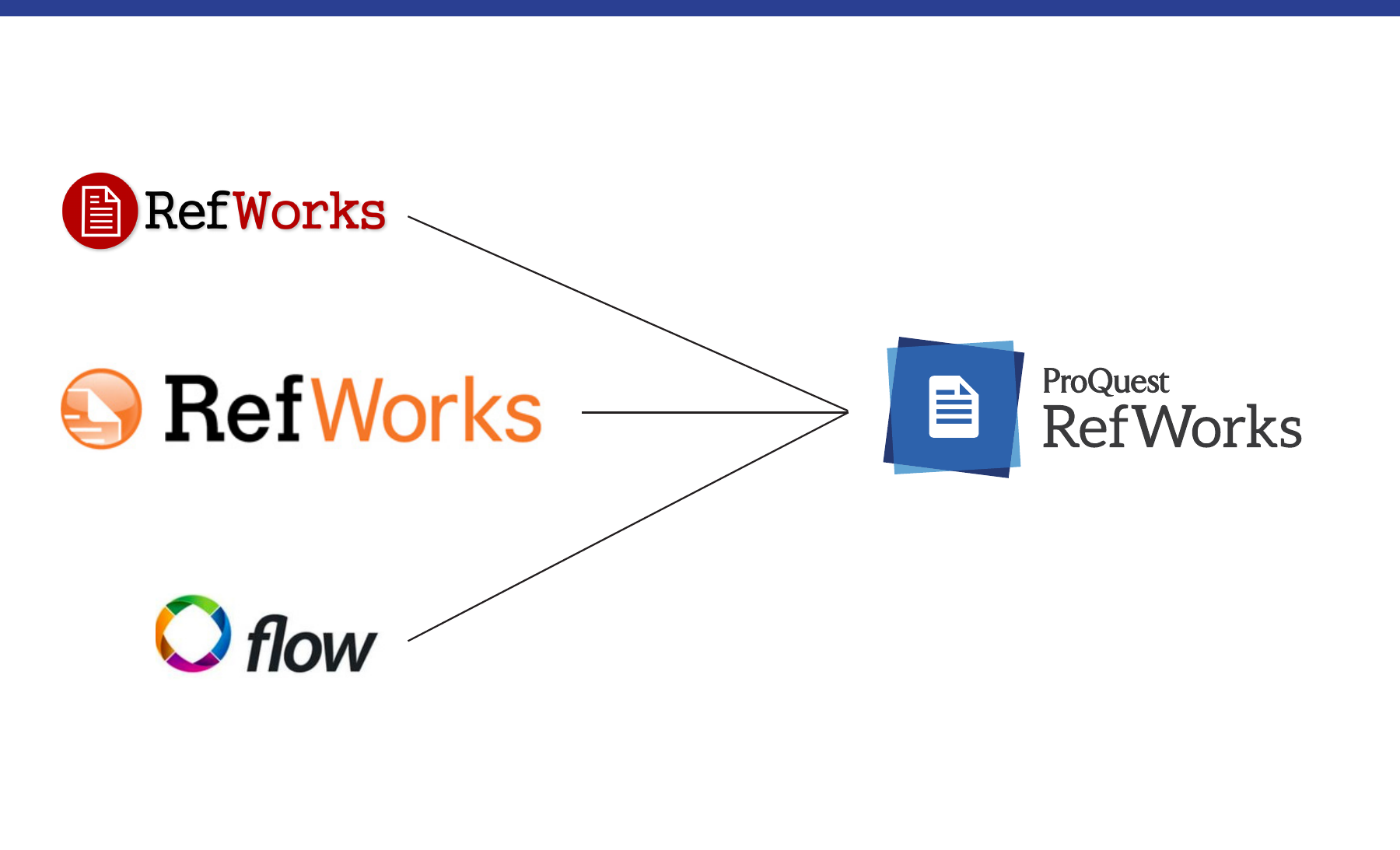
The immediate product challenge was to bring two generations of RefWorks and Flow together as one coherent research product—preserving established workflows while creating a foundation for the wider research journey.
Two generations of RefWorks + Flow → one product.
02 / THREE WAVES OF RESEARCH
Build the model. Work inside it. Expand what was possible.
The program became progressively closer to delivery: first establishing a shared language, then testing value propositions inside product work, and finally creating new workflows with discipline-specific research groups.
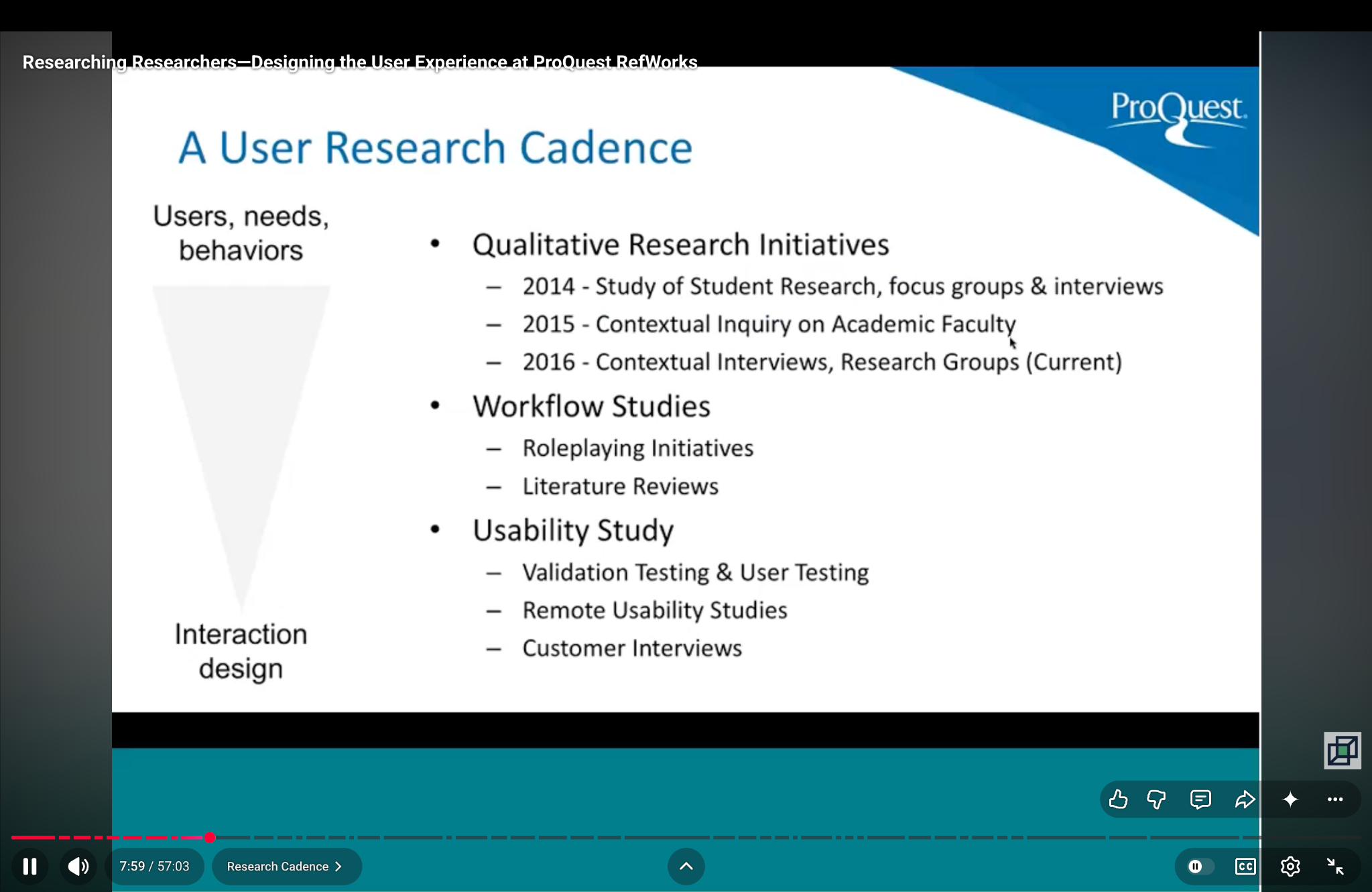
A user research cadence
PROGRAM TIMELINE / 2014—2016
The research practice developed across three connected waves: student research and focus groups; contextual inquiry with faculty; and contextual interviews with research groups. Workflow studies, prototypes, and usability testing carried the learning into delivery throughout.
WAVE 01 / FOUNDATION
Define the advanced researcher.
I served as ProQuest’s internal research lead, coordinating a three-person team with Andrew Hinton and another researcher from The Understanding Group. TUG authored the concluding personas; I carried the work into the organization and product portfolio.
K–12UndergradGraduatePhDAcademicProfessional
STARTING EVIDENCE / A BREADTH OF RESEARCHERSThe persona foundation located advanced researchers across a wider learning-to-professional continuum.
The population model gave product teams a shared way to discuss how research needs change with experience, institutional role, and responsibility.
I worked directly with research groups to broaden the market model, define explicit value propositions, and reduce an expansive opportunity space into a five-year roadmap that could be delivered on a rebuilt backend.
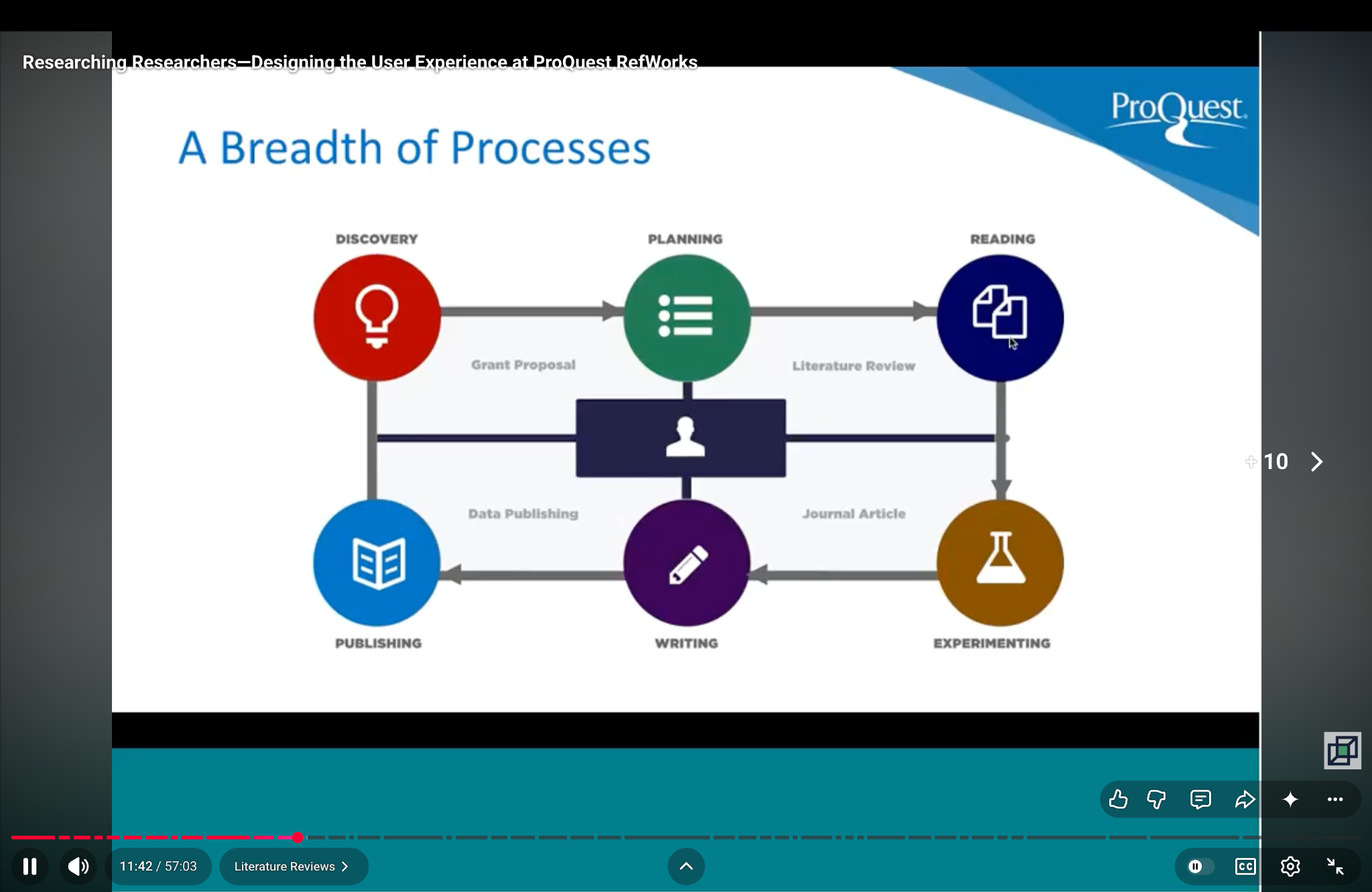
VALUE MODEL / THE RESEARCH CYCLEWe reframed the portfolio around a connected cycle of research work.
Discovery, planning, reading, experimenting, writing, and publishing became the shared frame. Grant proposals, literature reviews, journal articles, and data publishing showed where products and handoffs needed to connect.
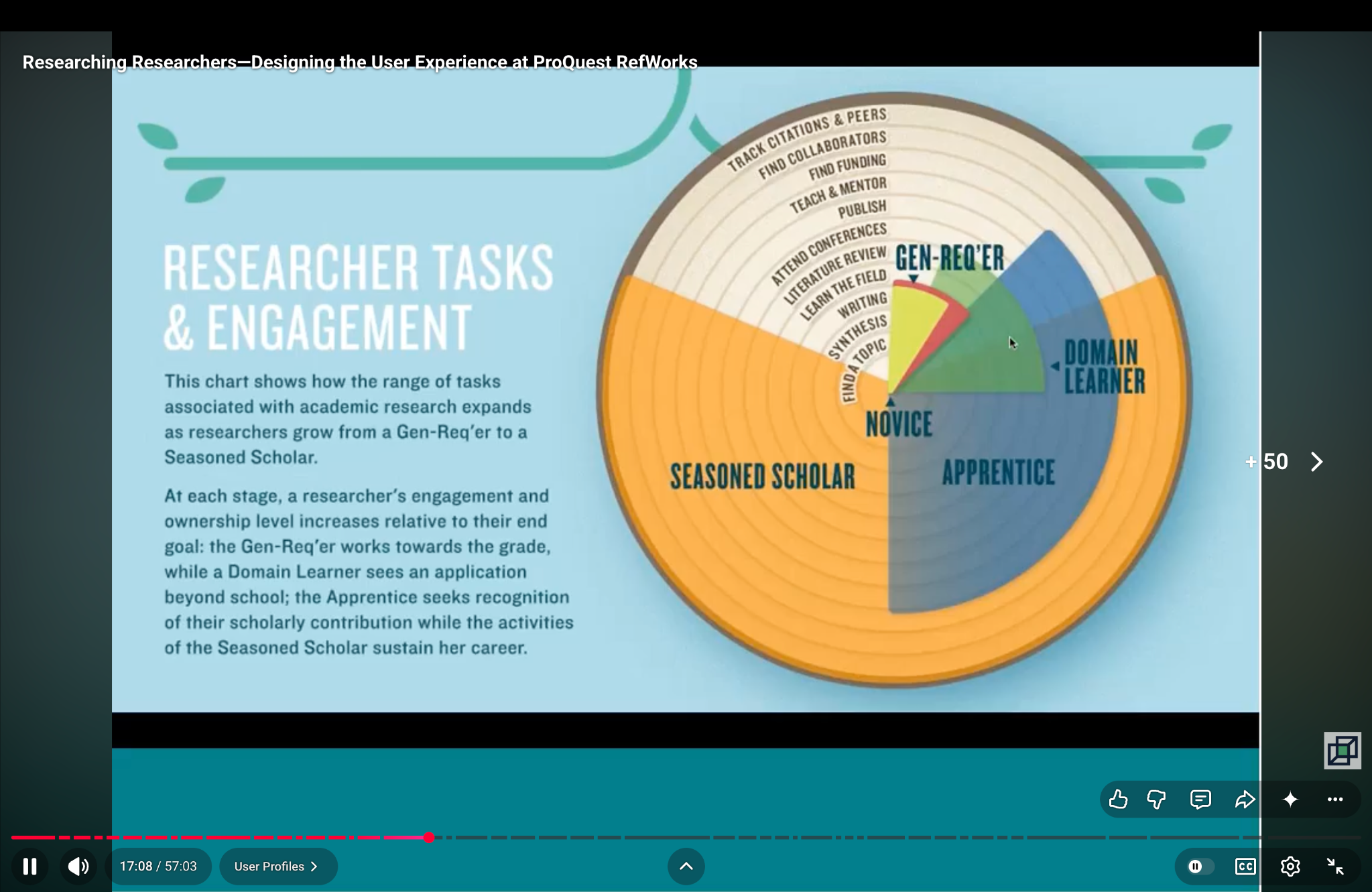
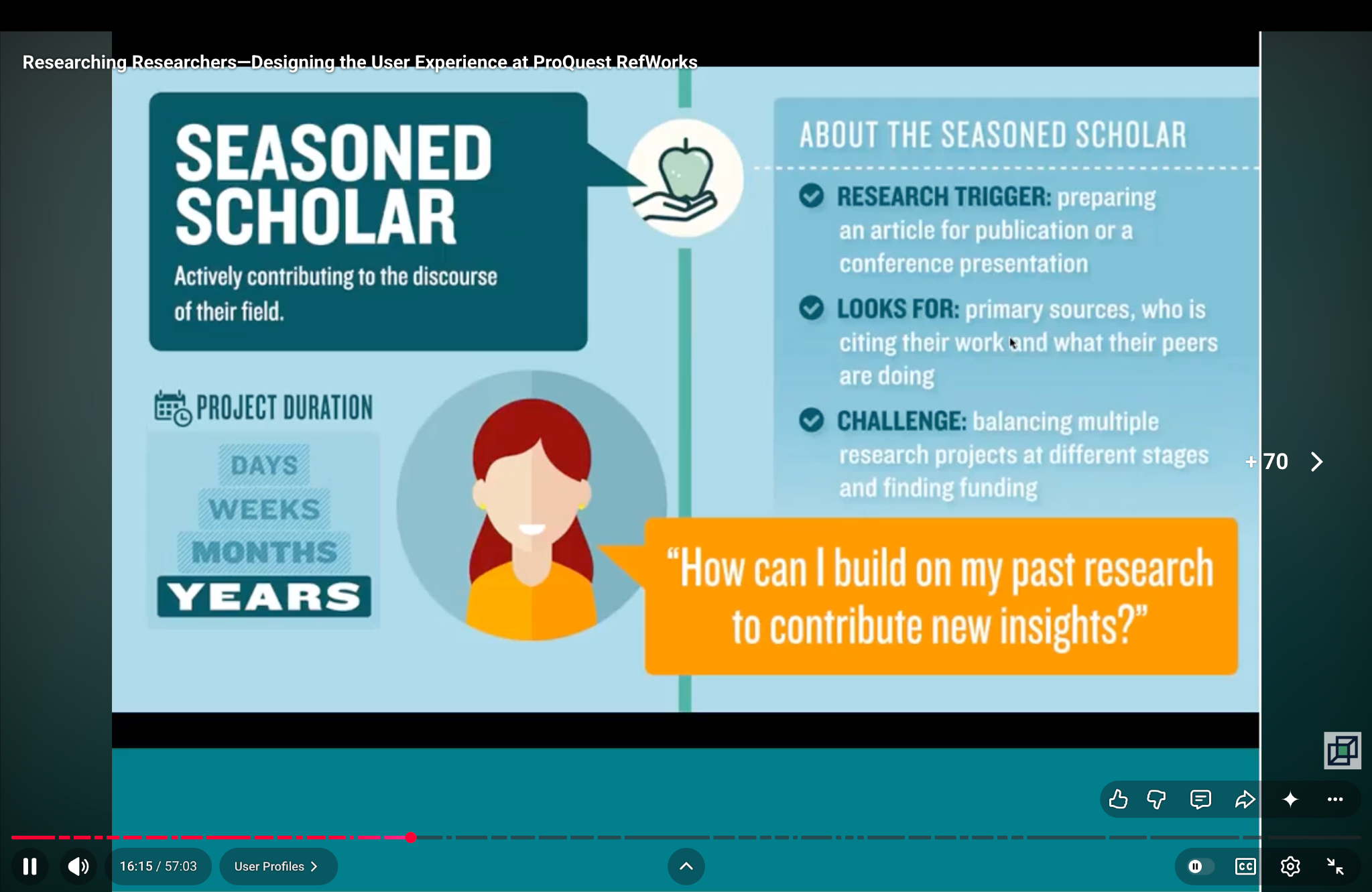
Discipline-specific research revealed that the journey also changed with scholarly maturity. As researchers gained expertise and ownership, their work expanded from finding and writing into synthesis, publication, teaching, funding, collaboration, and influence.
FINDING / RESEARCHER TASKS + ENGAGEMENTEach stage created different product entry points—and raised the stakes for continuity.
The model connected novice, domain learner, apprentice, and seasoned scholar roles to an expanding set of tasks. It showed where the portfolio could enter, support, and reconnect the work.
This is not a gallery of presentation slides. It is a working record of the program: its cadence, the contexts we entered, the workflows we reconstructed, and the breadth the resulting product model had to hold.
01 / CONTEXTUAL INQUIRY
Research in context
We went where research actually happened.
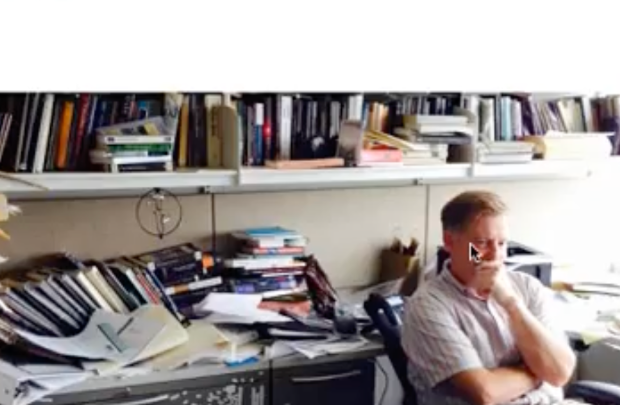
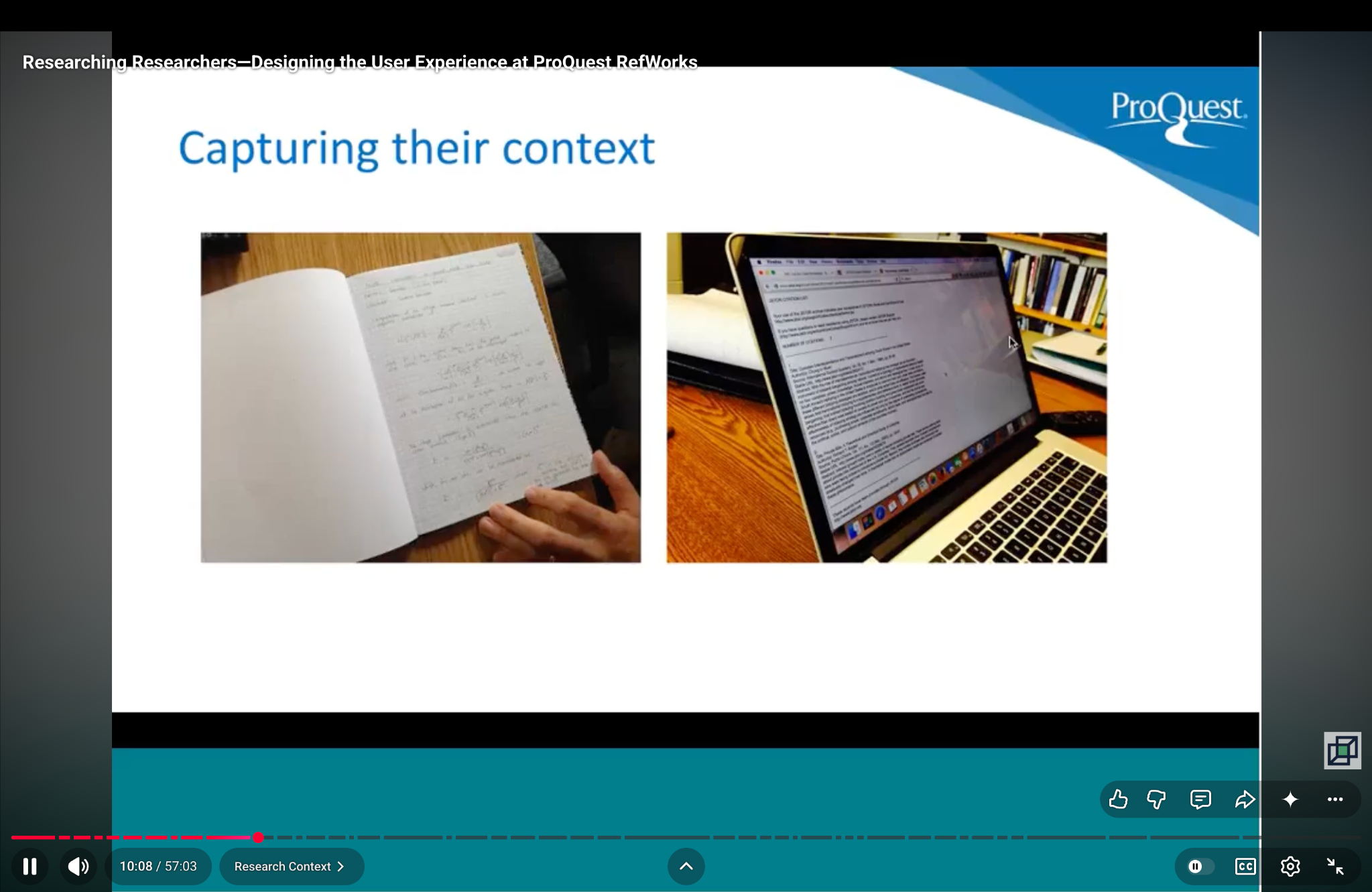
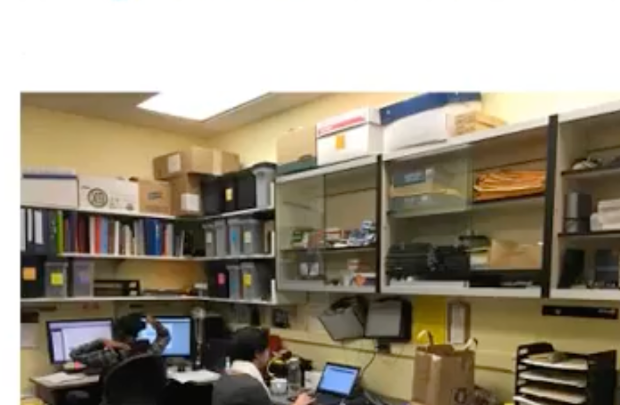
Labs and offices exposed the wider system surrounding RefWorks: notebooks, shelves, shared equipment, browser tabs, local files, and informal collaboration. The environment made needs visible that an interface interview alone could miss.
02 / FIELD EVIDENCE
The surrounding tools
The surrounding tools were part of the product problem.
We documented how physical notes, disciplinary databases, writing tools, and digital collections worked together. This evidence pushed the team beyond isolated citation tasks toward continuity across the whole research process.
03 / SAMPLE DIVERSITY
Across academic disciplines
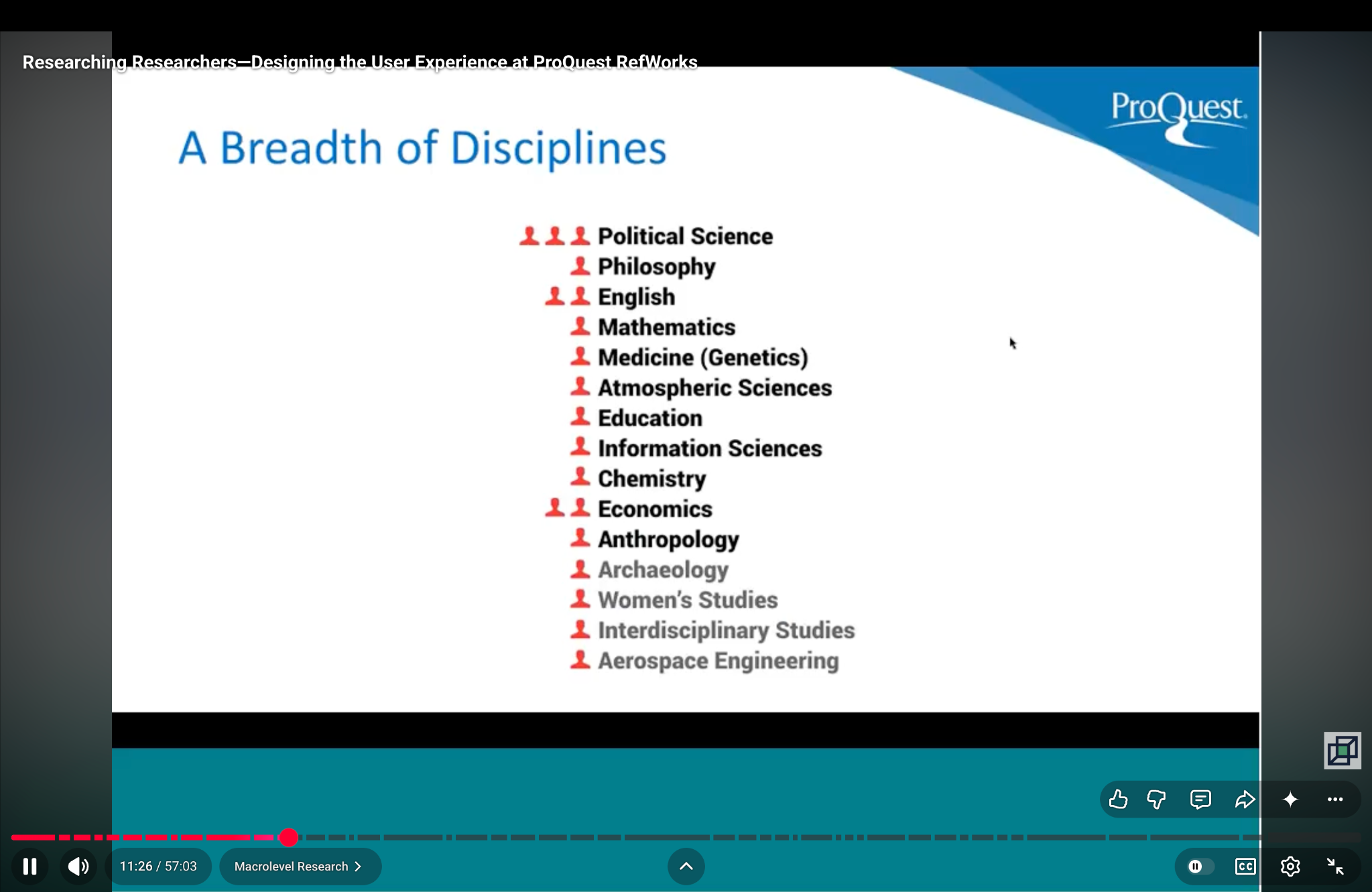
The model had to survive very different disciplines.
Participants crossed humanities, social sciences, medicine, mathematics, education, and engineering. The product needed durable primitives—projects, sources, groups, and citation—rather than assumptions inherited from a single field.
0103
03 / METHODS ATLAS
We used every useful angle—and stayed with the words.
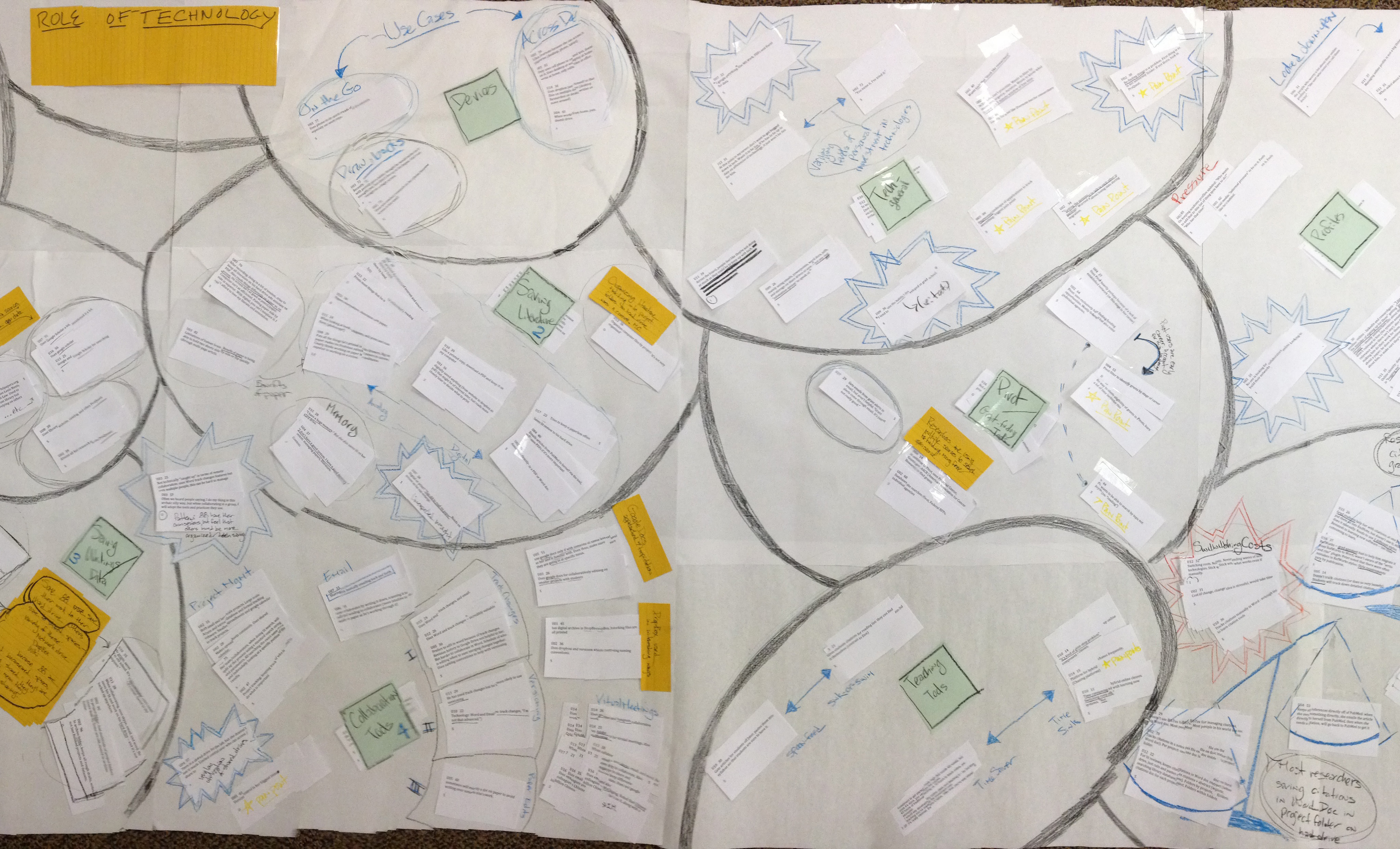
Each method contributed a different kind of evidence: observed behavior, institutional context, recurring language, interaction breakdowns, or a pattern strong enough to guide product direction.
Stakeholder + subject-matter interviews
Librarian visits and monthly team calls kept product leaders and subject-matter experts close to the changing institutional context. We used them to connect retention pressure, service realities, and the wider portfolio.
VISIT NOTES + MONTHLY CALL RECORD
Librarian interviews
Anna Rouben and I studied both specialist and academic librarians. We treated them as buyers, administrators, quality gatekeepers, and frontline partners helping students and faculty use the product well.
LIBRARIAN STUDY + ANNA ROUBEN CREDIT
Researcher interviews
Interviews were abundant, with the most concentrated work in 2015 and 2016 across wave one and the beginning of wave two. Researchers’ own language became the basis for personas, value propositions, and feature framing.
During wave two I visited research labs and observed groups where projects, literature, collaboration, and discipline-specific practices actually met. The surrounding work mattered as much as the interface.
Wave one established the general research journey; wave three revisited it by discipline. In education research, we mapped how ERIC discovery could feed directly into RefWorks as material ready to read, organize, and use.
LITERATURE REVIEW / RECONSTRUCTED WORKFLOW
Diary studies
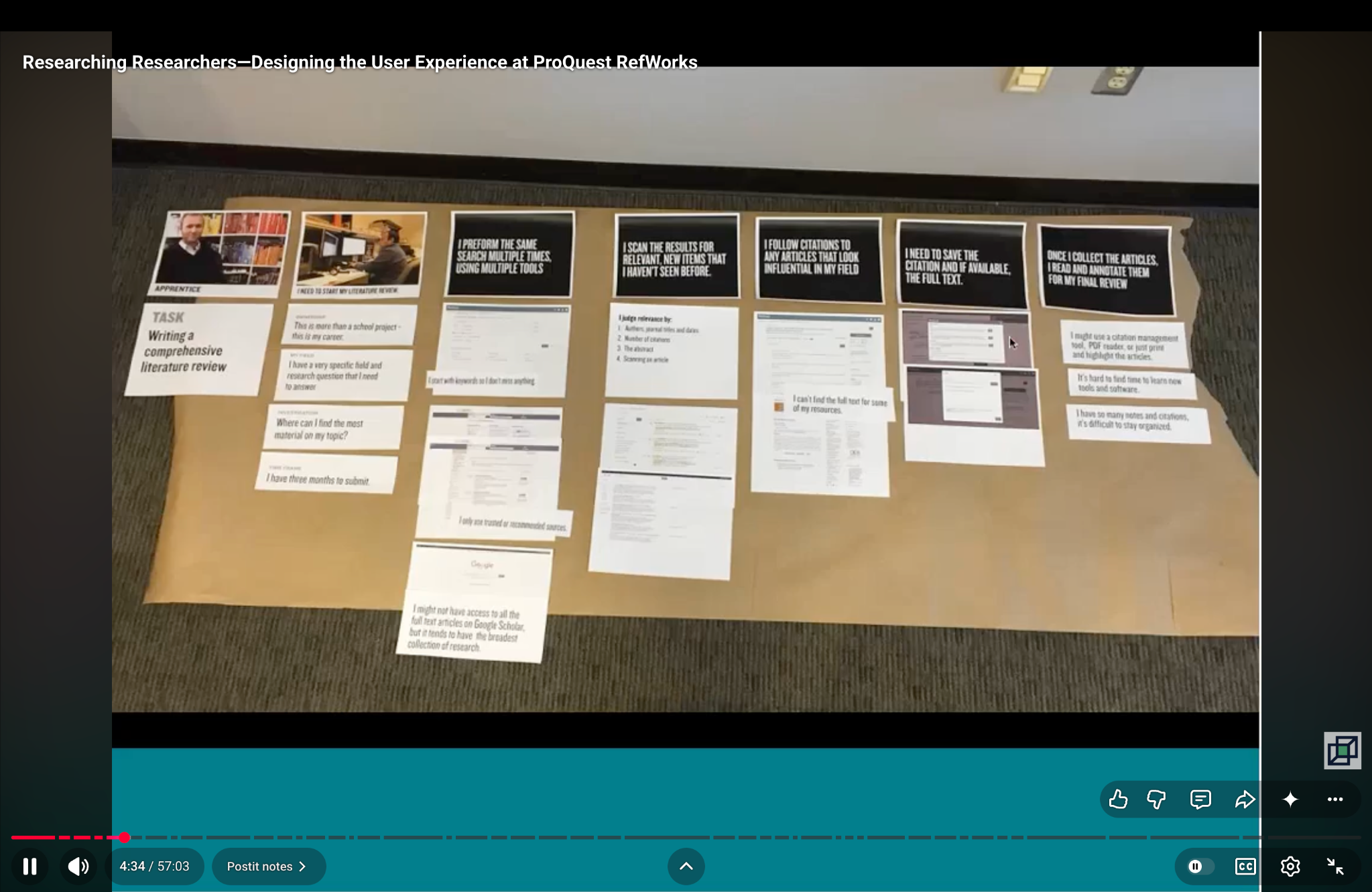
Graduate students and new associate professors repeatedly walked us through how they configured and used RefWorks. We turned those accounts into reports describing taxonomies of folders, feeds, and evolving research practices.
DIARY ACCOUNTS → LITERATURE REVIEW MODEL
Surveys + quantitative research
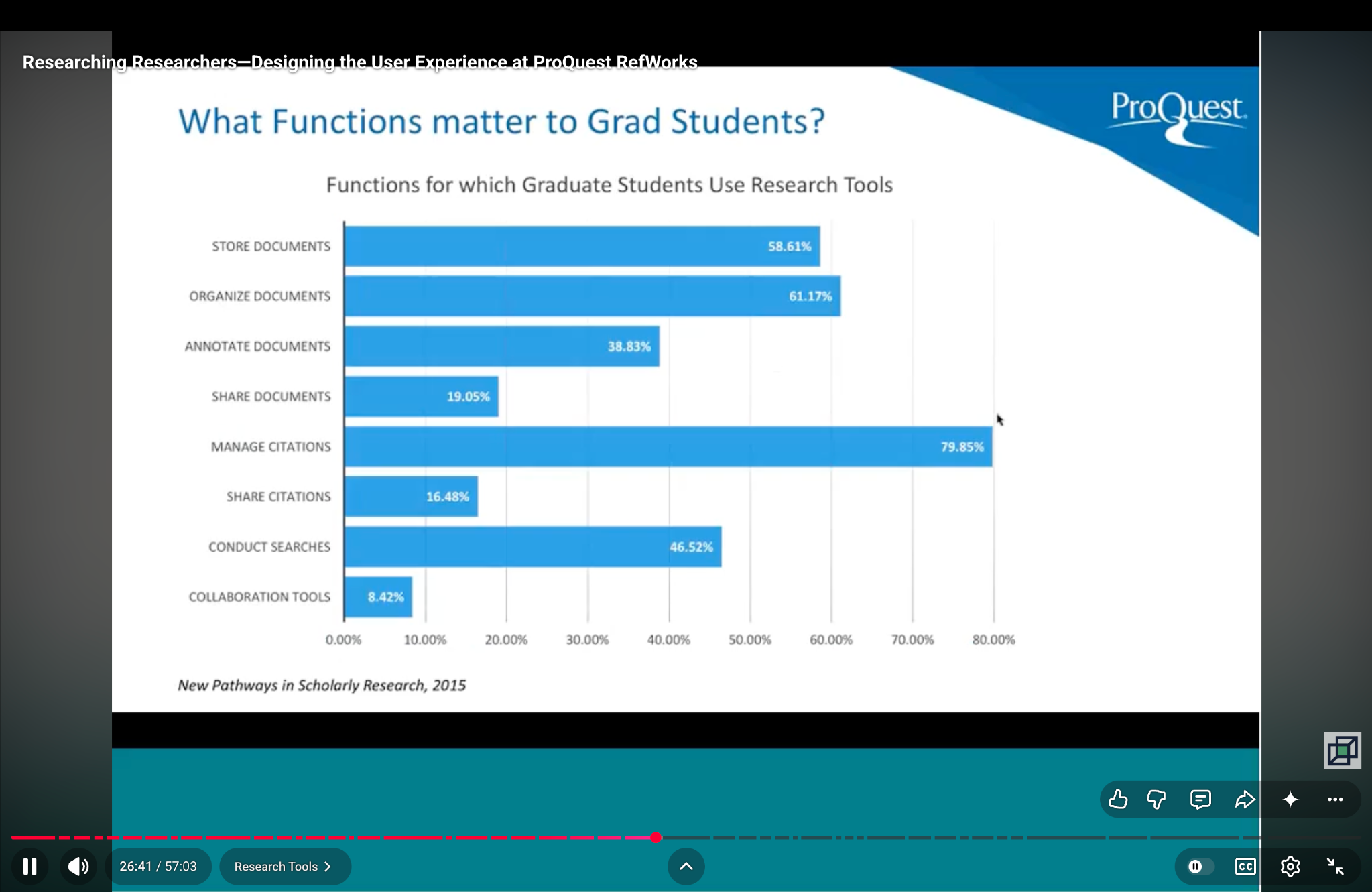
I analyzed NPS responses in depth, manually coding the corpus into a working database. Alongside that work, 2015 survey data clarified the functional baseline: graduate students most often used research tools to manage citations, organize documents, and store material, while sharing and collaboration remained less established behaviors.
SURVEY EVIDENCE / NEW PATHWAYS IN SCHOLARLY RESEARCH, 2015
Competitive research
I personally used EndNote, Zotero, and Mendeley, captured screens, and completed comparative task analysis. A PM partner connected that work to market analysis and a SWOT that moved through the director to the VP of Workflow Solutions.
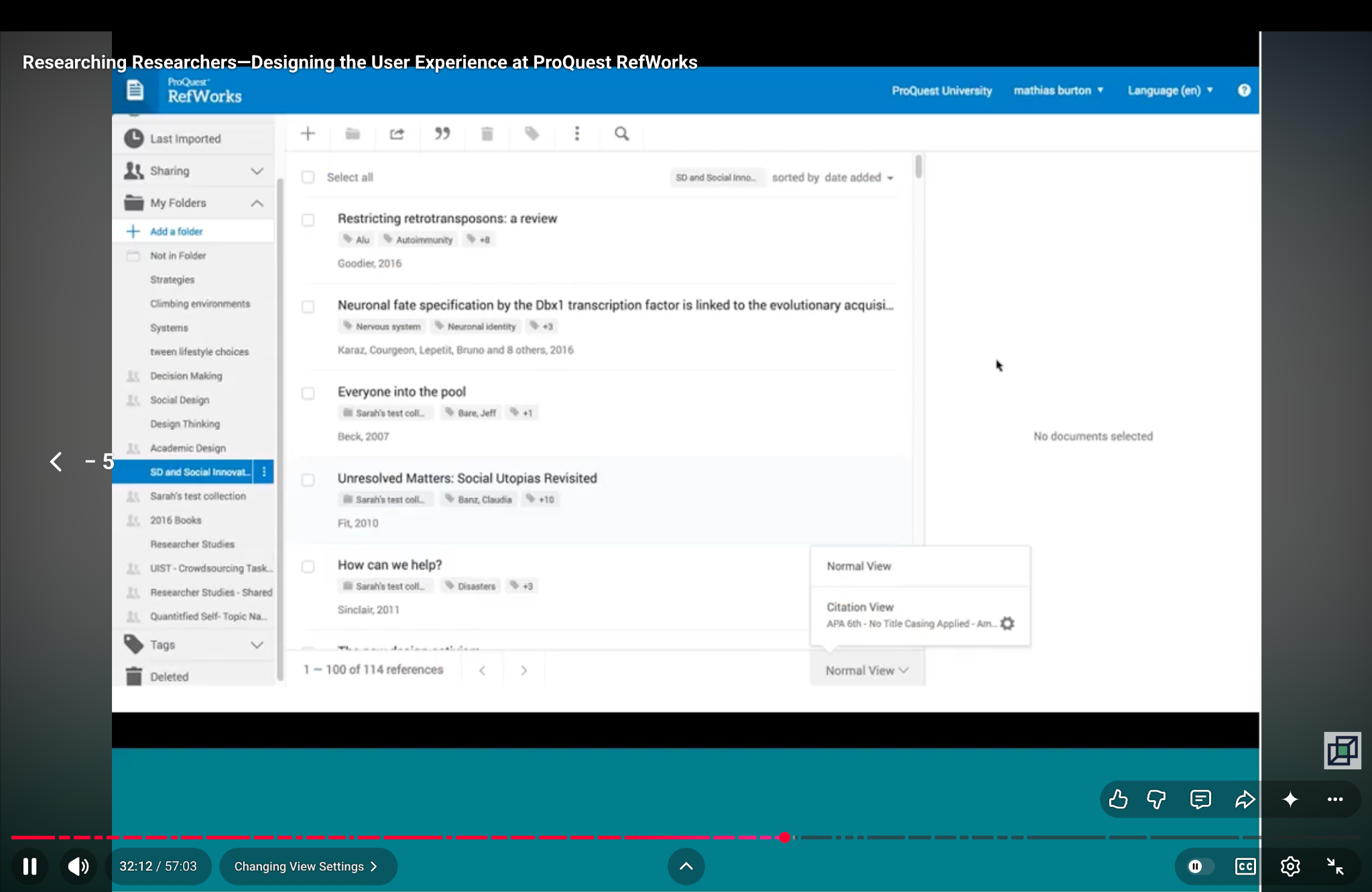
Using each participant’s own library, I narrated a proposed feature workflow and invited them to react. Sessions moved fluidly between evaluating the concept and describing what they wished the product could enable. I built InVision prototypes and gathered feedback from a recurring customer group. The alternative views feature—Normal View and Citation View—shows how these cycles brought an output task into the active library.
I ran quarterly usability studies, codified the findings, and presented the resulting research report in the QBR so product decisions remained connected to observed behavior.
QUARTERLY USABILITY / QBR REPORT
Participatory design + co-creation
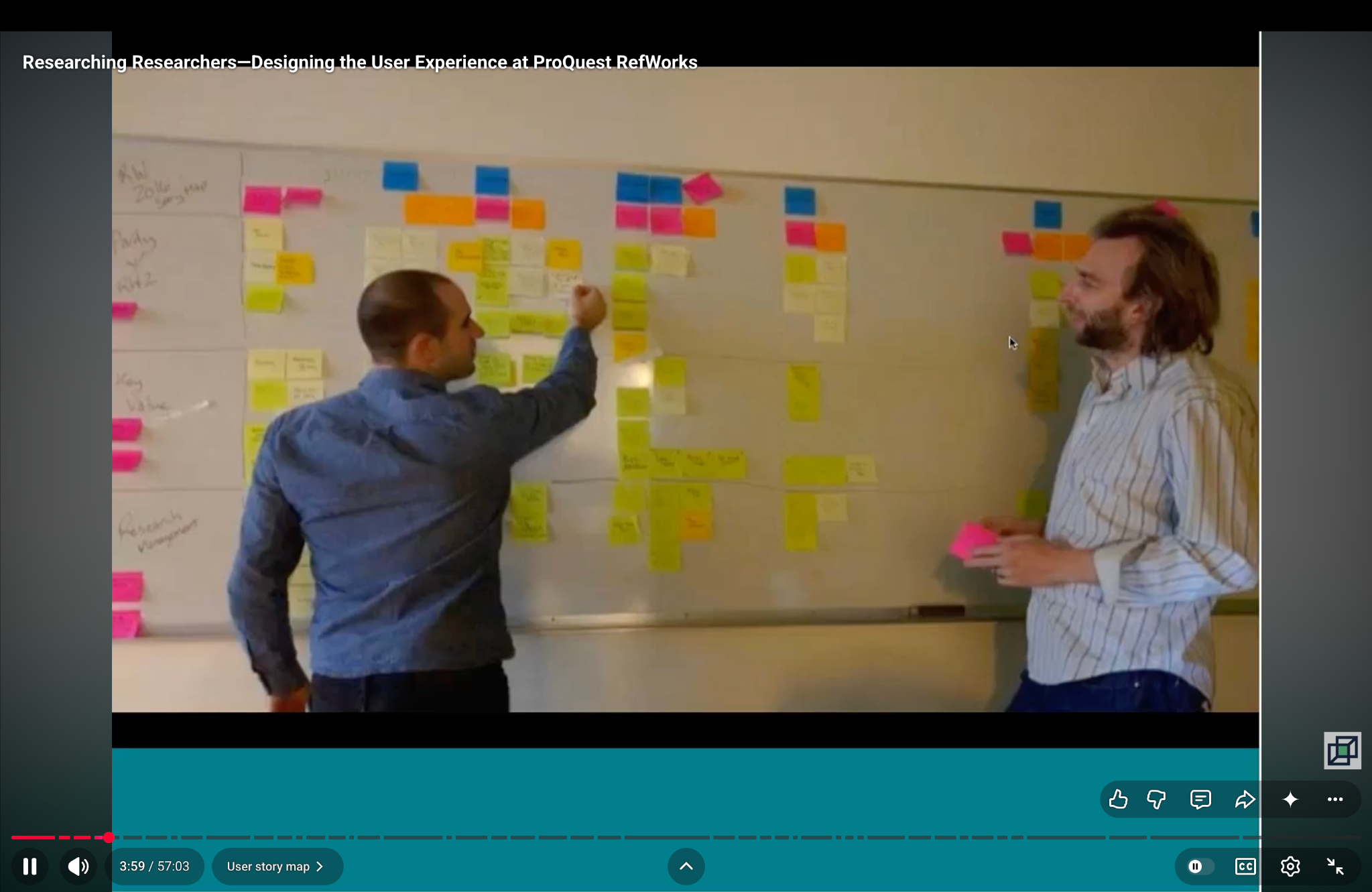
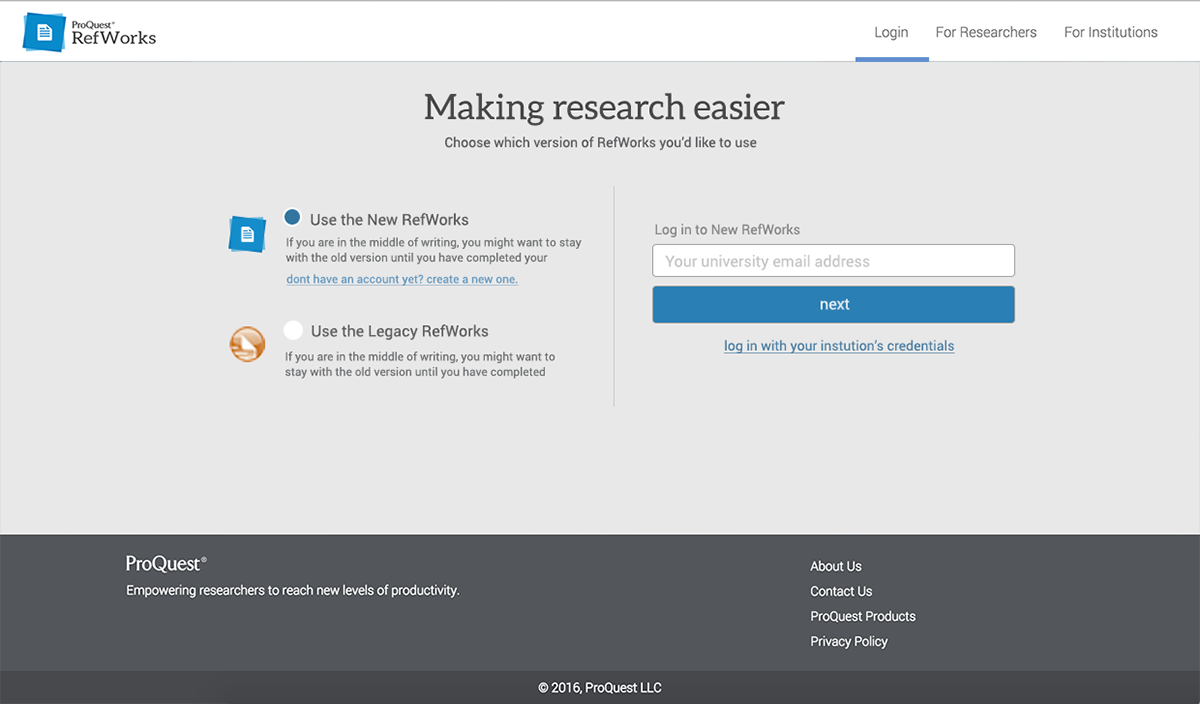
I translated evidence with the people responsible for delivery—not after research was complete. Here, an engineering lead and I built a story map together, using the researcher workflow to connect technical decisions with the product experience. Partnership with Yale similarly shaped a login experience that made student workflows more autonomous.
CROSS-FUNCTIONAL STORY MAP / RESEARCH INTO DELIVERY
Repository, support + analytics
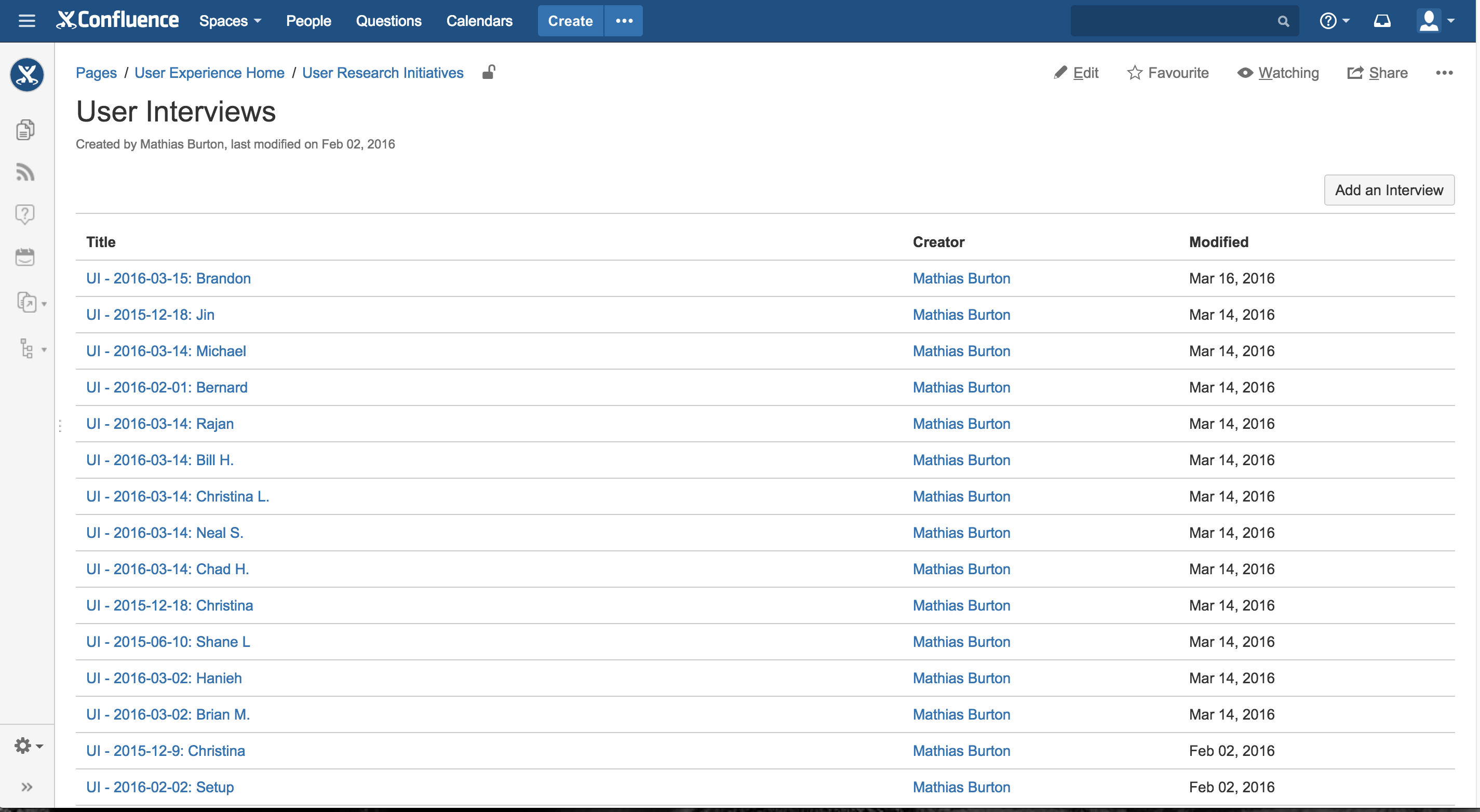
I connected qualitative findings with product analytics, customer-support evidence, and the growing UX repository. Interview records and research findings were available in the company’s knowledge base, giving colleagues access to the evidence behind product decisions. That shared memory helped the team return to established needs—such as seasoned scholars building on past work—without beginning each decision from zero.
COMPANY KNOWLEDGE BASE / RESEARCH REPOSITORY
Longitudinal follow-up
I maintained relationships with participants and built a reusable contact repository for the team. Follow-up let us revisit how long-running projects, multiple concurrent studies, funding, and scholarly contribution changed over time.
FOLLOW-UP / BUILDING ON PAST RESEARCH
Group-dynamics research
Classes and research groups revealed that organization was social as well as personal. Prefilled folders and subscriptions let a group begin from the same canonical literature set.
SHARED LITERATURE / GROUP MODEL
04 / THE PRODUCT MODEL
Turn a personal pile of references into a reusable research environment.
The research reframed RefWorks around continuity. Sources entered an inbox, found a project, became part of a durable structure, could be shared with a group, and remained useful through writing and citation.
01CaptureBring sources and open-browser research into one place.
02ClusterConnect new material to the project it belongs to.
03OrganizeBuild a folder structure that survives the work.
04SubscribeShare a canonical collection with a class or group.
05CiteCarry trusted material into writing and publication.
04A / RESEARCH INTO INTERFACE
One redesign shows the larger operating principle.
Citation view is a compact example of the program at work: observe a consequential task, identify how the inherited system obscures it, then preserve the power while moving control into the researcher’s active context.
01 / OBSERVED FRICTION
The legacy library
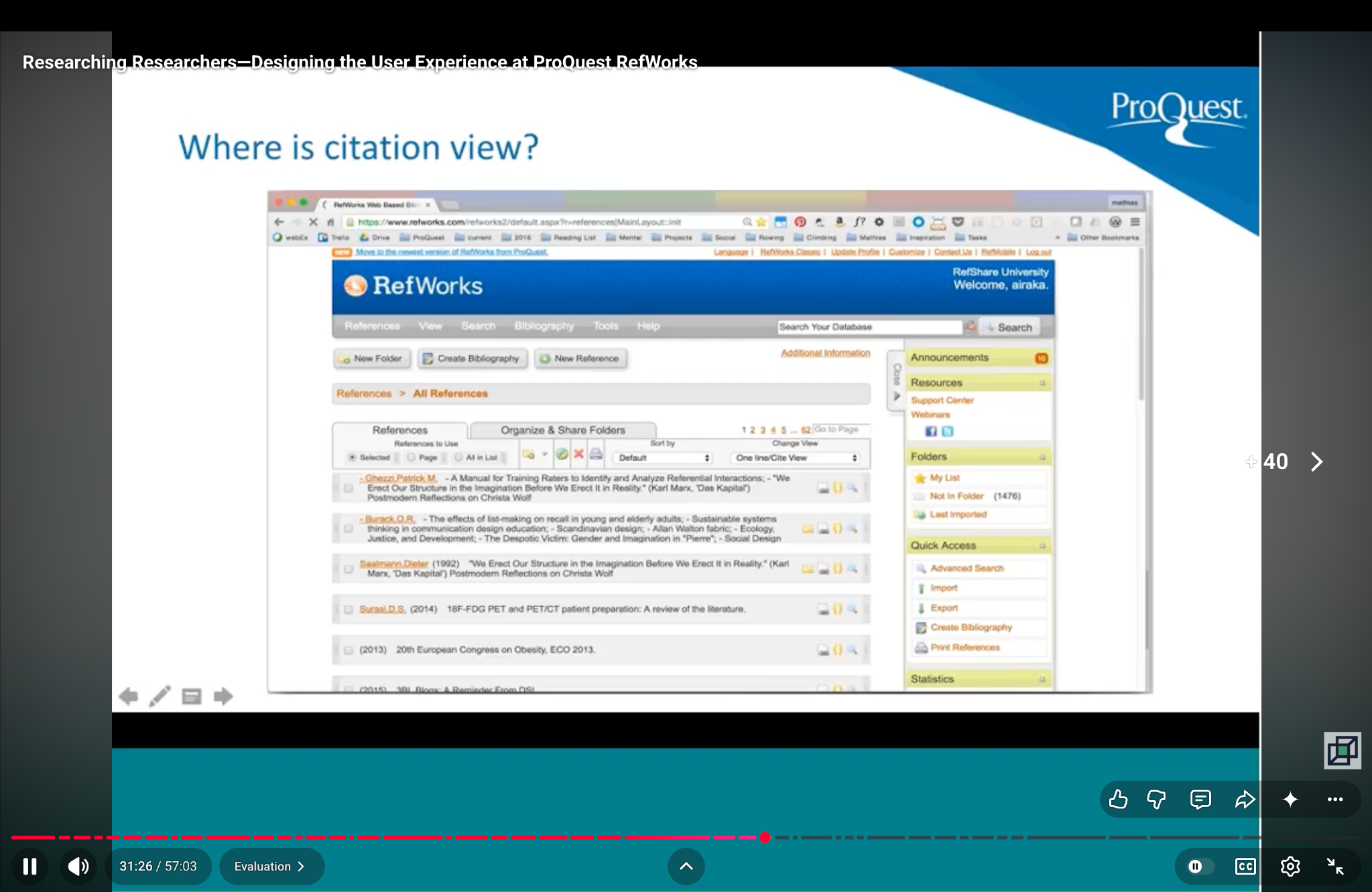
Can you find the citation view?
The legacy interface hid an essential output inside a dense reference-management system. Finding the feature was itself a usability problem, especially for people learning the product through a librarian, class, or institutional rollout.
02 / SYSTEM MISMATCH
Customizing citation view
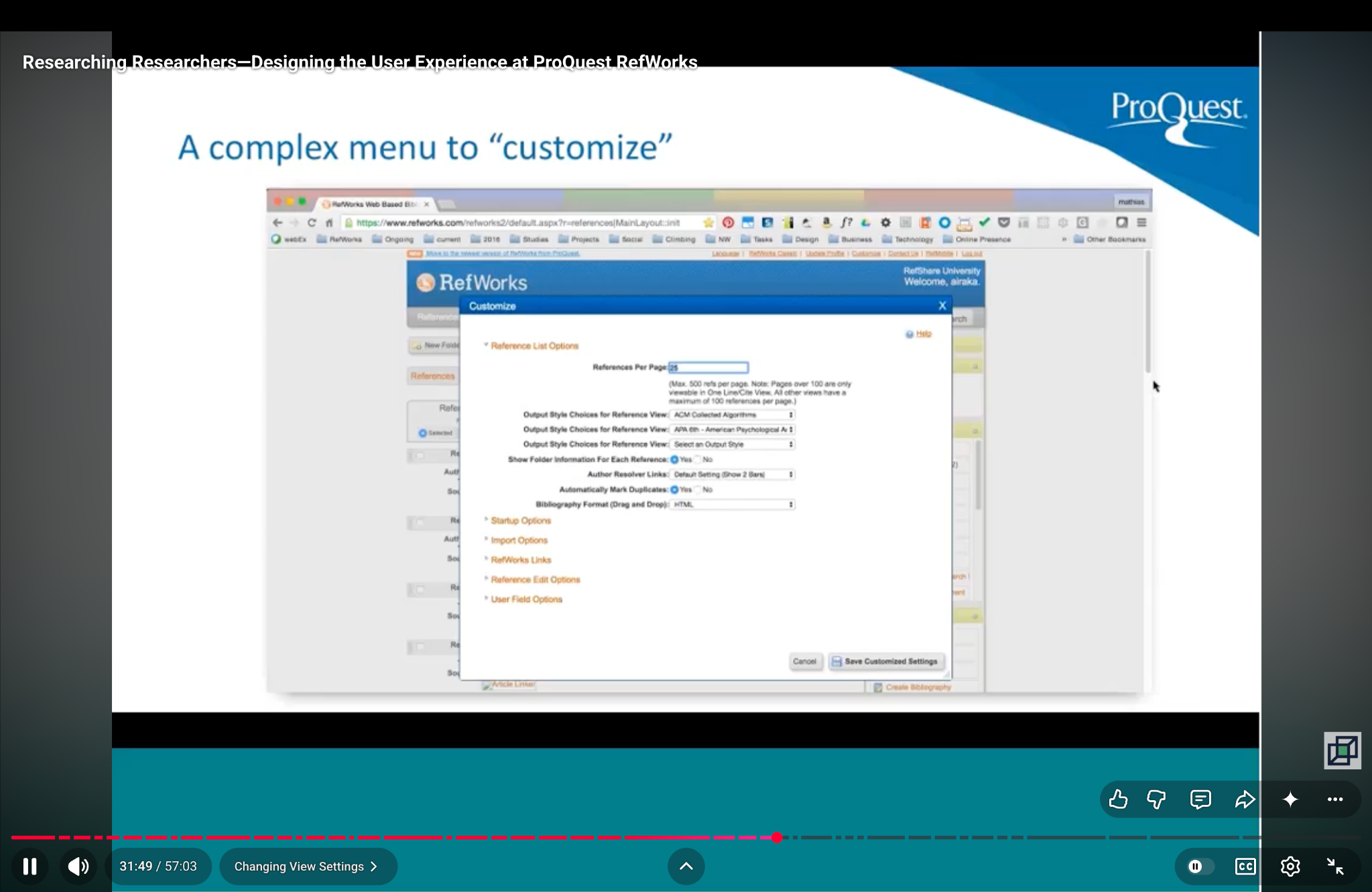
Advanced control reflected the software model.
Customization existed, but it was buried in a settings dialog and separated from the active research library. The interaction exposed how accumulated capability could still make a common task feel indirect.
03 / DESIGN RESPONSE
Alternative views in the active library
We moved the choice to the point of work.
The redesigned library surfaced Normal View and Citation View where researchers were already working. One collection could move cleanly between record management and the formatted references needed for writing.
04 / CONTEXTUAL CONTROL
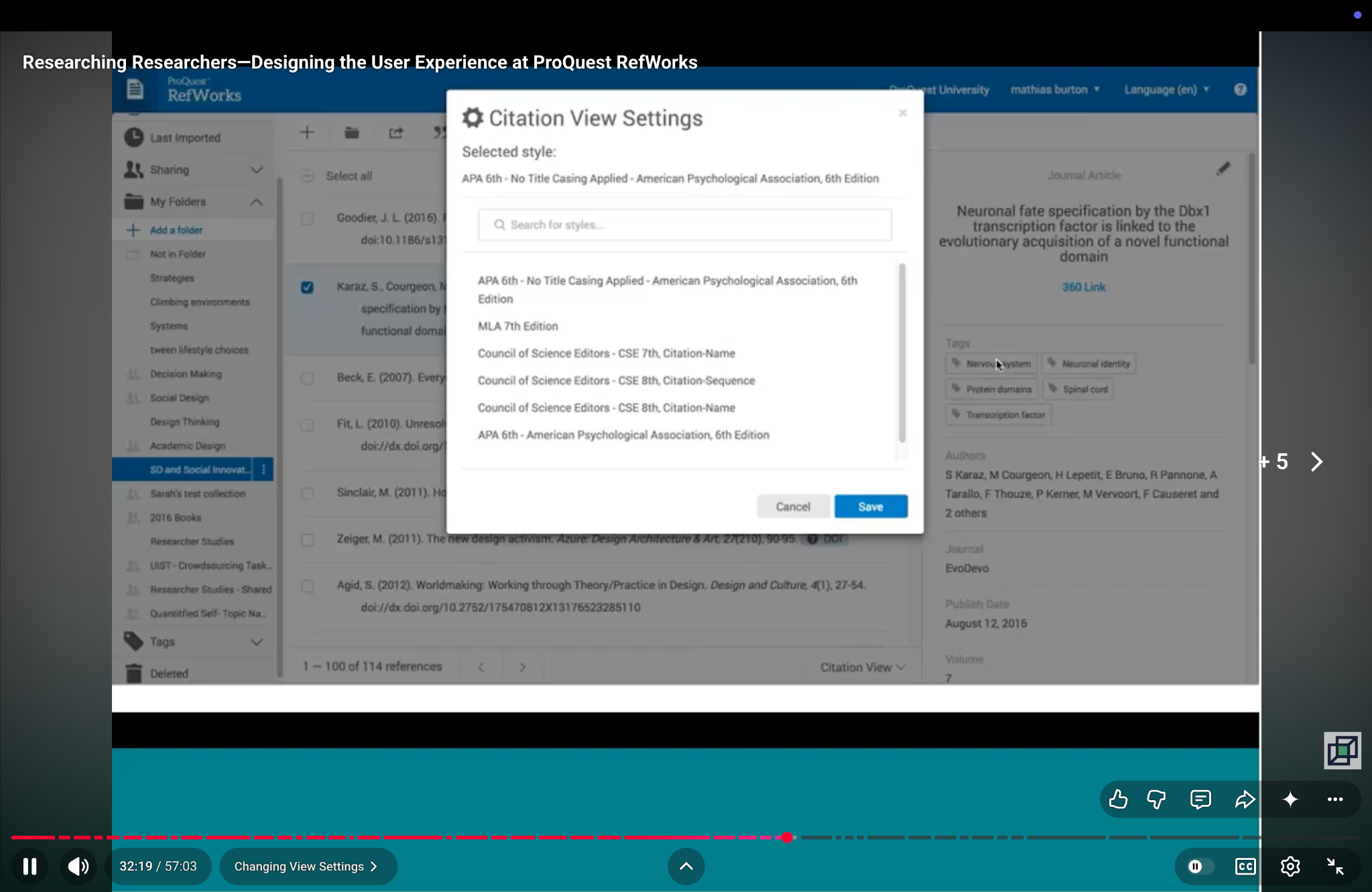
Citation view settings
A buried configuration became an immediate decision.
Citation styles became searchable and changeable without leaving the active library. The design kept sophisticated capability while reducing the effort required to understand and use it.
0104
04B / PORTFOLIO STRATEGY
The opportunity extended beyond managing citations.
These concepts translated recurring research needs into a broader product horizon: direct access to material, trusted group collections, visible research state, and coordination. Together they made the case for RefWorks as an active research environment.
01 / EARLY MODEL
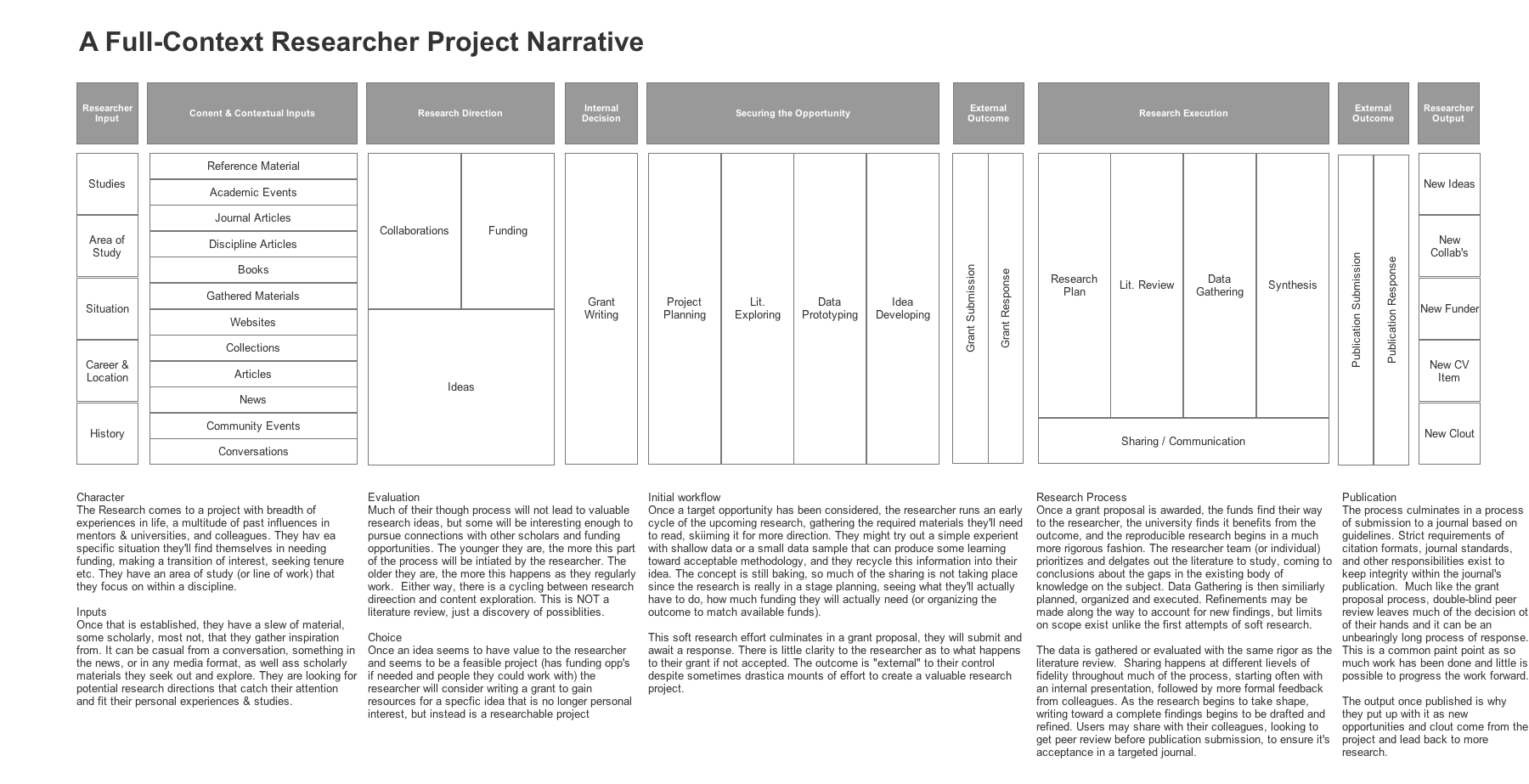
A full-context researcher project narrative
Map the whole project before shaping the interface.
This early artifact traced the wider research project—from prior experience and contextual inputs through funding, execution, and publication. It provided a way to discuss where product concepts could support continuity across that work.
02 / ACCESS
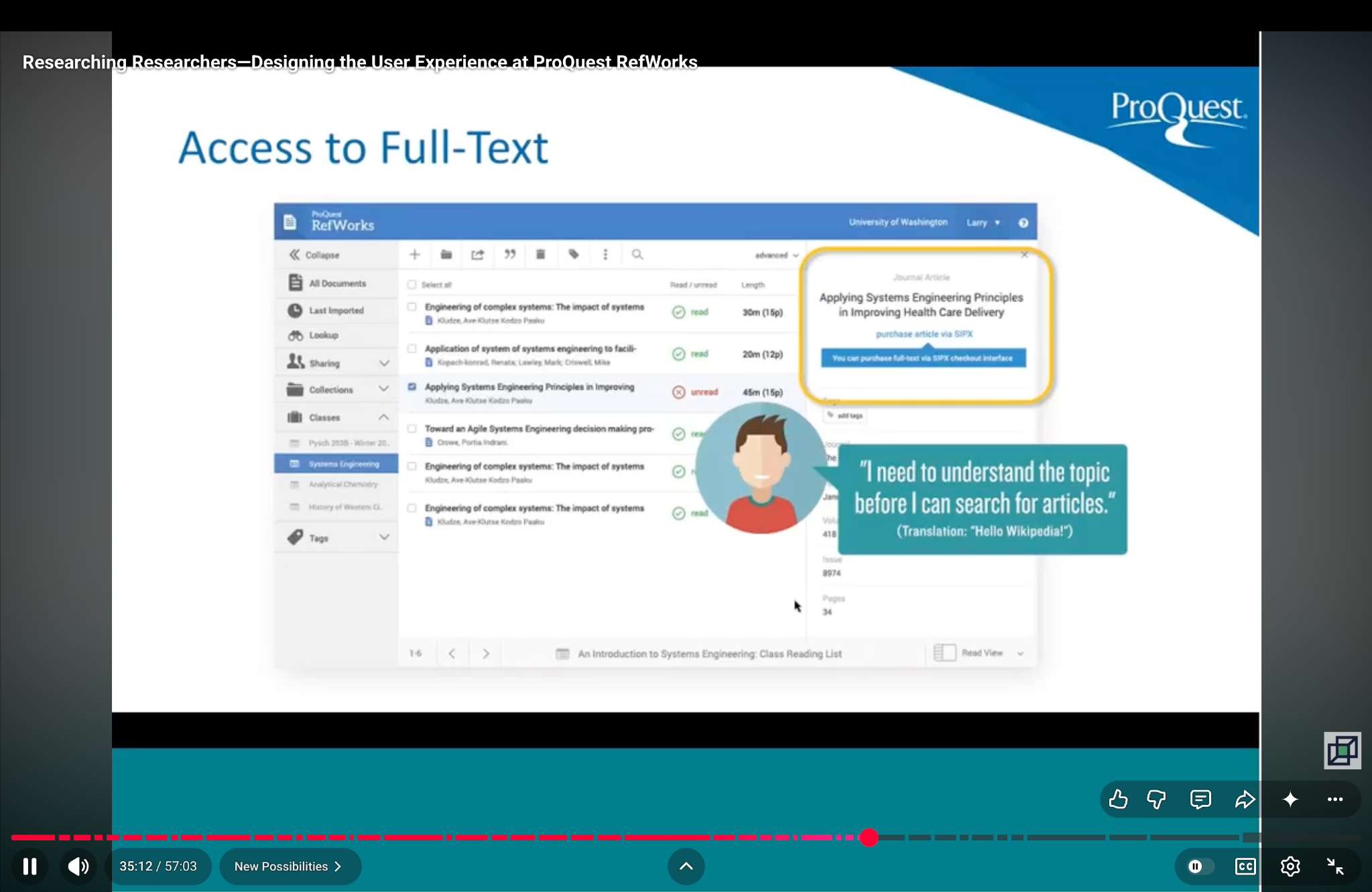
Access to full text
Connect discovery directly to reading.
The concept brought institutional full-text access into the working collection. Researchers could move from understanding a topic to reading the source without rebuilding the search somewhere else.
03 / TRUSTED COLLECTIONS
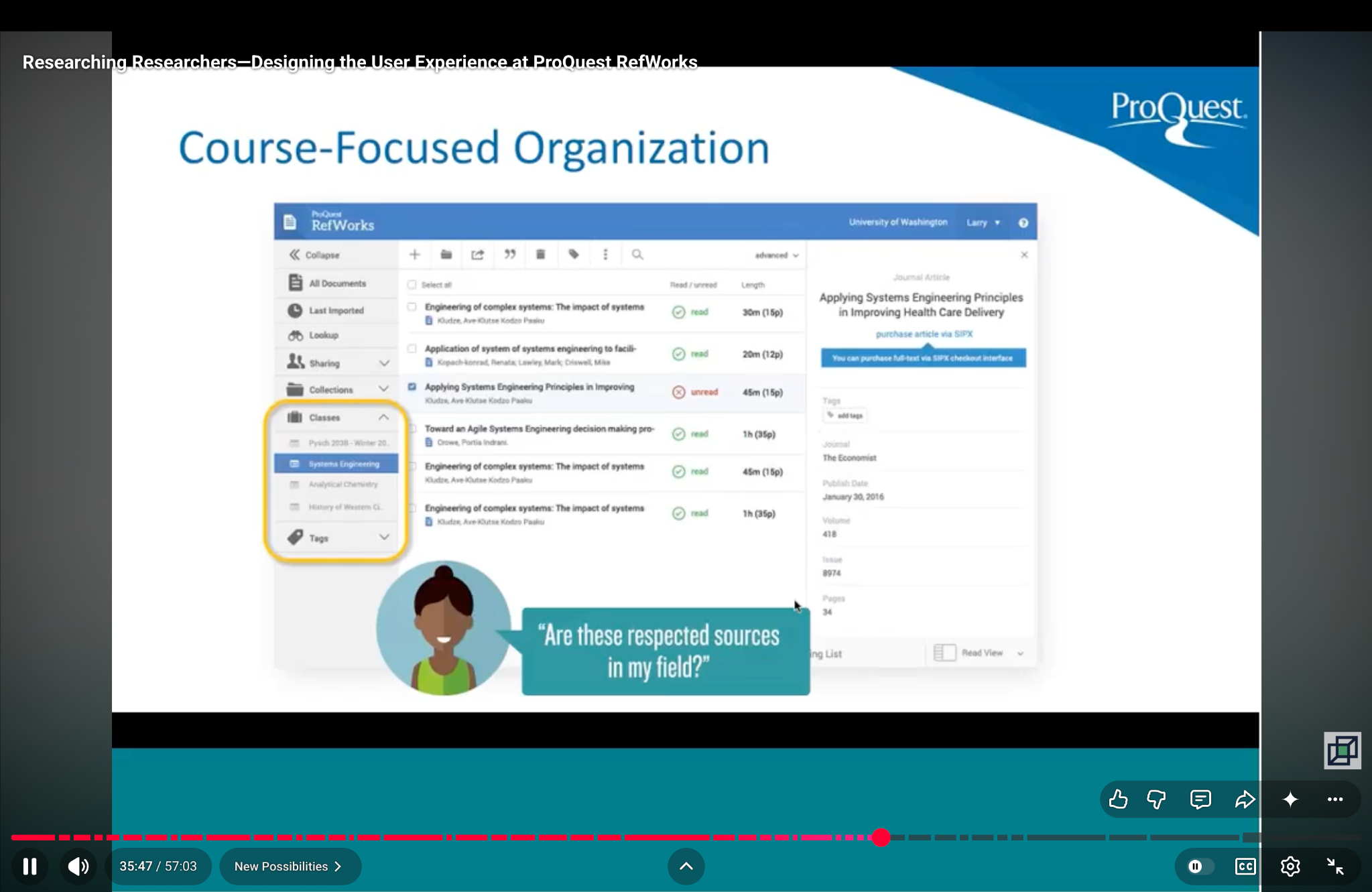
Course-focused organization
Let a group begin from the same foundation.
Course-focused collections let librarians and instructors curate respected sources while giving students a shared, trusted starting point. Organization became social infrastructure, not only personal filing.
04 / RESEARCH STATE
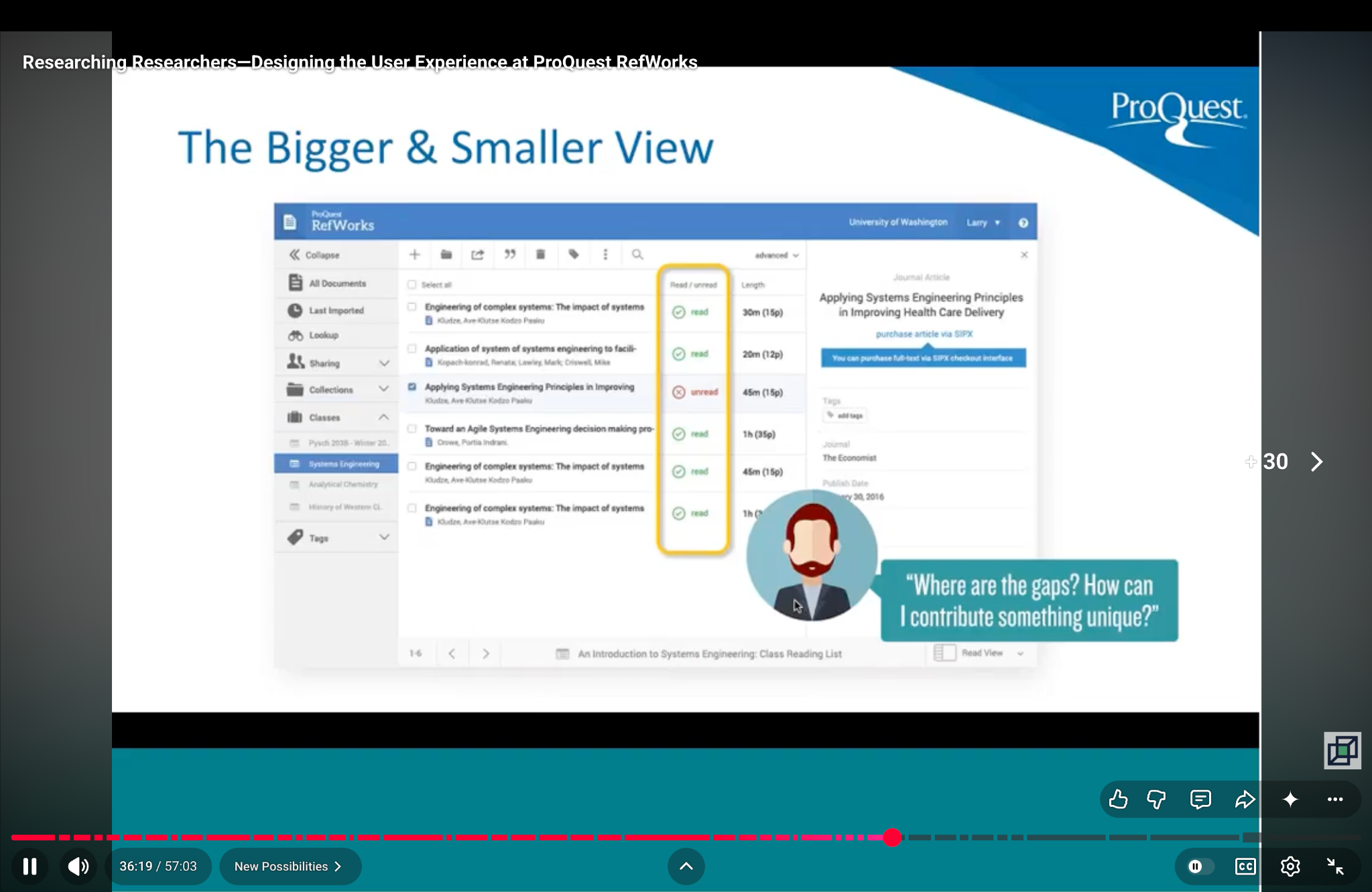
The bigger and smaller view
Support the bigger question and the next action.
Read state served both scales of research: the portfolio-level question ‘Where are the gaps?’ and the immediate decision ‘What should I read next?’ The same signal helped orient both individual and group work.
05 / COORDINATION
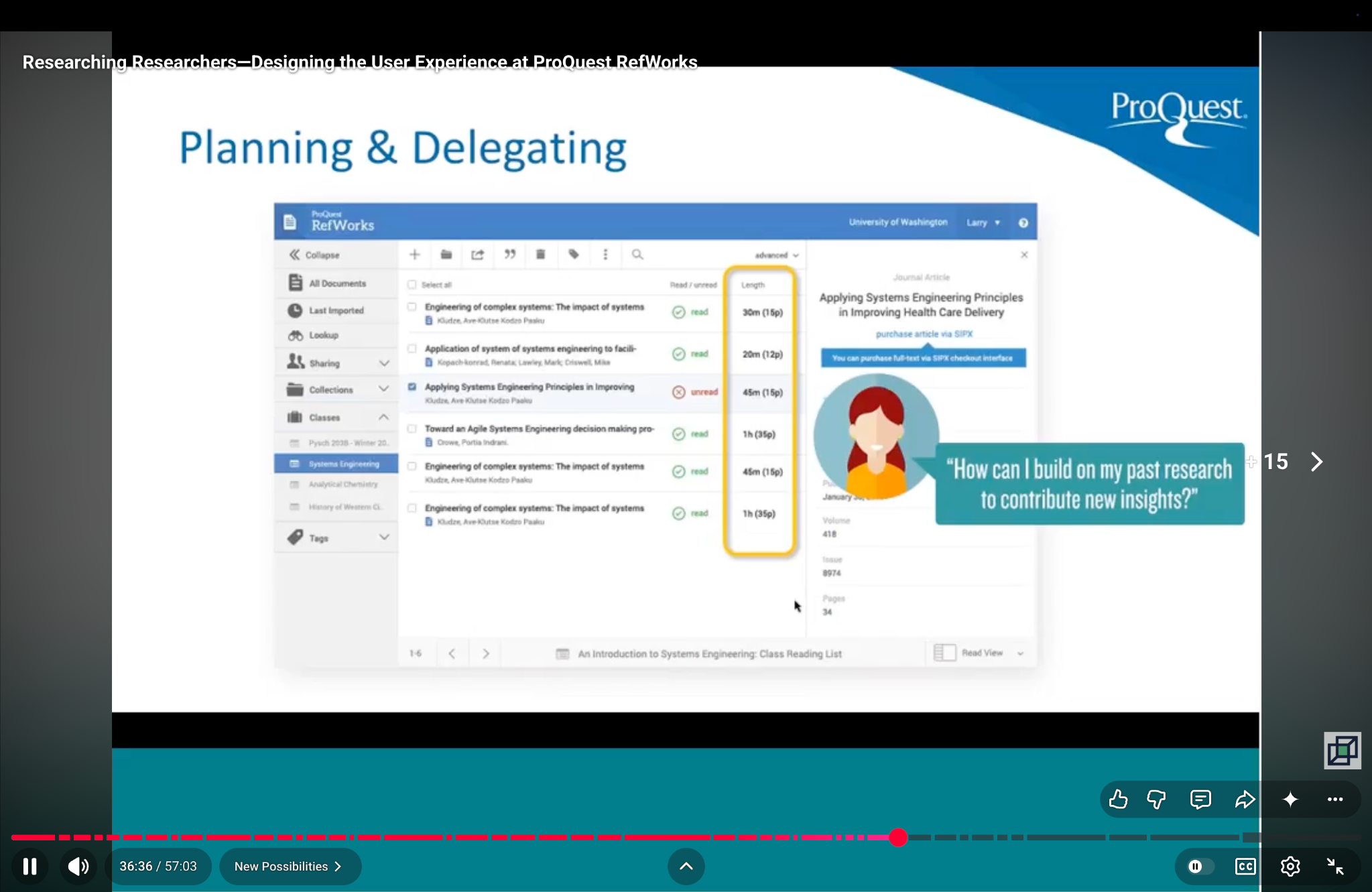
Planning and delegation
Make a literature set plan-able.
Estimated reading effort made a collection more actionable. It supported prioritization, delegation, and coordination across a research group—extending RefWorks from storage into active project planning.
0105
05 / RESEARCH → PRODUCT
Four decisions made the research reusable.
The program became tangible in product choices that cleaned the library, organized work by project, preserved the discovery trail, and made trusted collections shareable.
01 / CLEAN THE LIBRARY
Find and consolidate duplicate records.
Duplicates accumulated constantly and made saved libraries unreliable. We created a tool that identified likely matches, suggested consolidation, and helped researchers restore a consistent record set.
01
CLEAN THE LIBRARY
02 / ORGANIZE BY PROJECT
Give incoming research somewhere meaningful to land.
Researchers had invented incompatible personal systems that became messy and difficult to reuse. Project-oriented inbox clustering and folders made organization explicit, durable, and easier to return to.
02
ORGANIZE BY PROJECT
03 / CAPTURE THE TRAIL
Turn open browser tabs into an active research list.
Instead of letting discovery disappear across dozens of tabs, the capture experience brought sources and their metadata into RefWorks, where researchers could organize, outline, and continue the work.
03
CAPTURE THE TRAIL
04 / SHARE THE FOUNDATION
Start a class or group with the same literature.
Prefilled folders let librarians, instructors, and research leads establish a trusted reading set. Participants could subscribe to the collection and work from the same version instead of rebuilding it independently.
Stabilize the product. Leave a direction that could keep growing.
The relaunch produced incremental rather than explosive growth—but it stopped further business loss, retained Yale, improved user sentiment and reviews, and gave RefWorks a viable path forward on a rebuilt foundation.
RefWorks remains active in 2026. Clarivate continues to ship improvements across projects, imports, collaboration, PDF reading, accessibility, and duplicate management. Yale still provides RefWorks to its students and affiliates. Those later developments are not my direct work, but they show that the product and several needs we identified endured.
ProQuest was where I became a research-first practitioner. I was researching researchers—people whose own careers depended on turning incomplete evidence into defensible knowledge. That meta experience permanently changed how I approach product work.