What the deck documents
Research methods and themes, three design questions, design principles, an iterative process, and paired mentee–mentor screens.
CONNECTIE / TEN-WEEK UCD PROJECT
From a focus tool to a peer-mentoring concept: how research and iteration changed what we chose to build.
I’m revisiting this graduate project through RIPEN & TASTE, the language I use today for investigating a problem and carrying evidence into action. The original deck describes a UCD process; this is a retrospective mapping of our team’s work, not a claim that we used these framework names at the time.
READ THE ORIGINAL PRESENTATION · 24 PAGES ↗The short project makes the whole loop visible. Research changed the question; a broad set of ideas made the scope problem visible; prototyping and evaluation helped the team narrow the direction.
Begin with a hypothesis about distraction, pressure, and adapting to college.
Recognize the range of student concerns, then encounter the temptation to address them all.
Concentrate on connecting a student with a mentor who can offer guidance.
02 / RIPEN
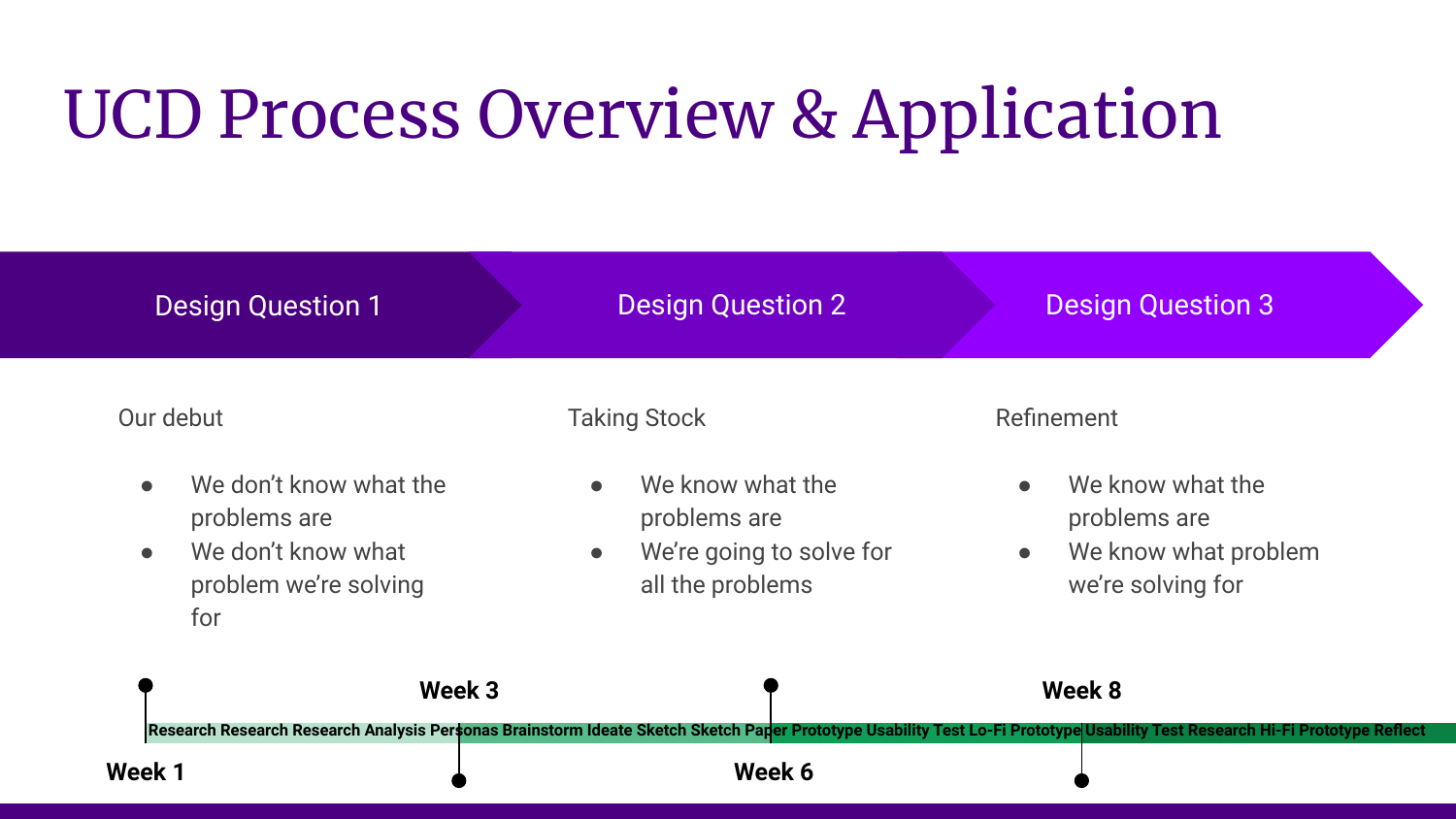
Research → Ideation → Prototyping → Evaluation → Needfinding. The sequence returned to research as the team learned what the concept needed to become.
The starting hypothesis connected incoming students’ difficulties to deadlines, digital distractions, and mental wellness. The team used two first-year student interviews, mentor interviews, an online survey, and in-person guerrilla storytelling to investigate what entering college felt like.
The issues varied widely, extended beyond first-year students, and crossed schoolwork, family, and social life. A focus tool was too narrow a starting answer.
The second design question asked how students could balance social and academic responsibilities in a healthy way. Ideas included a button for difficult moments, first-year wellness classes, and a social space for mental wellness. The first instinct was to combine them.
The team’s tactical findings called for simplicity. Mentors had provided help across the different problems, suggesting a common mechanism: a conversation with another person.
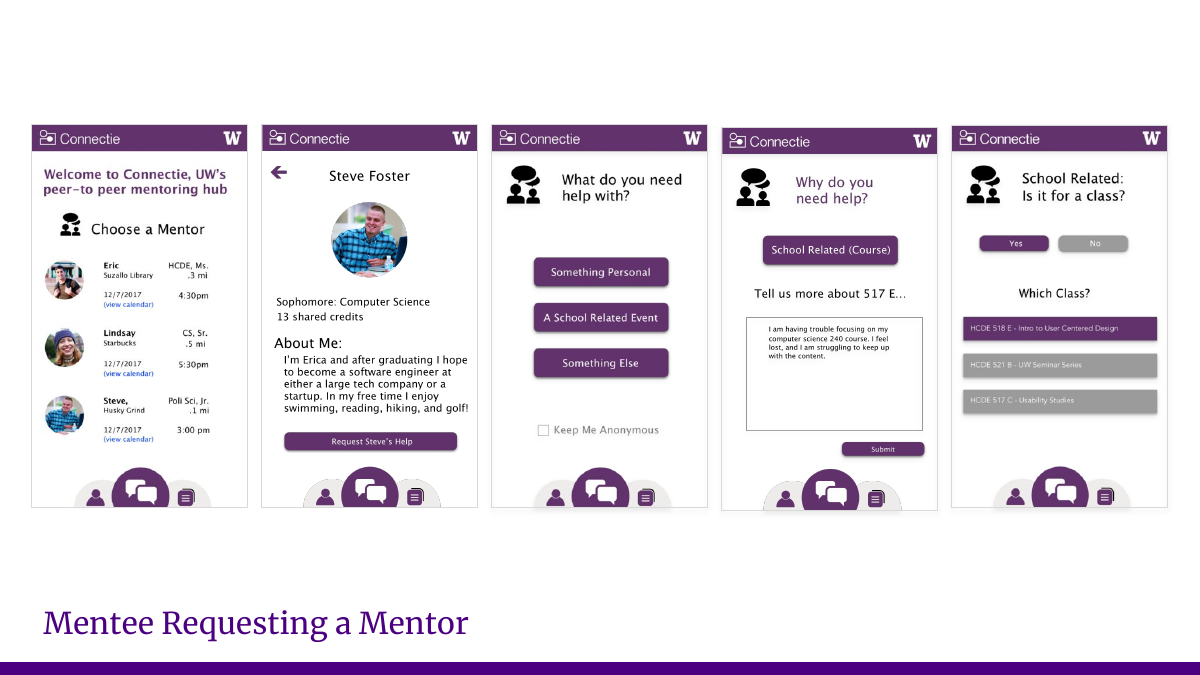
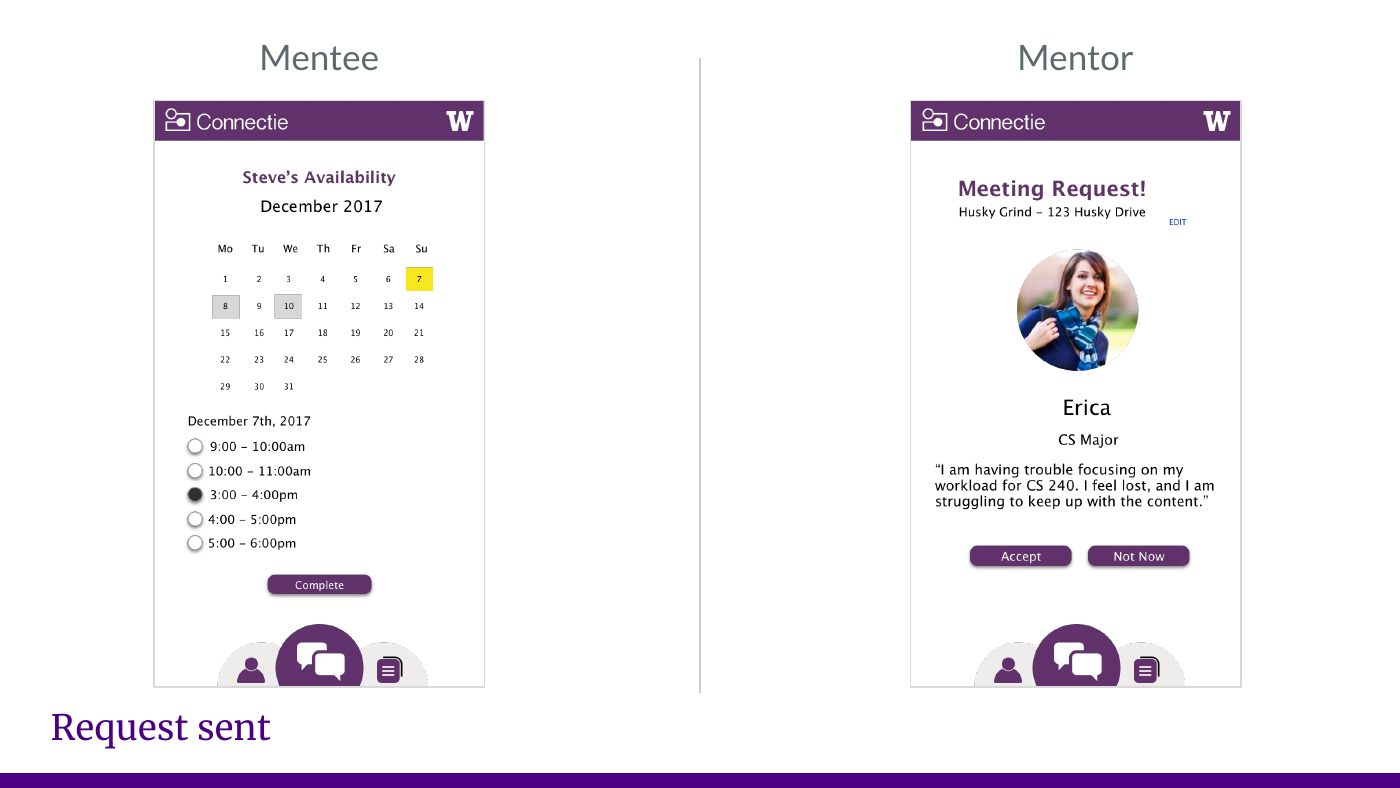
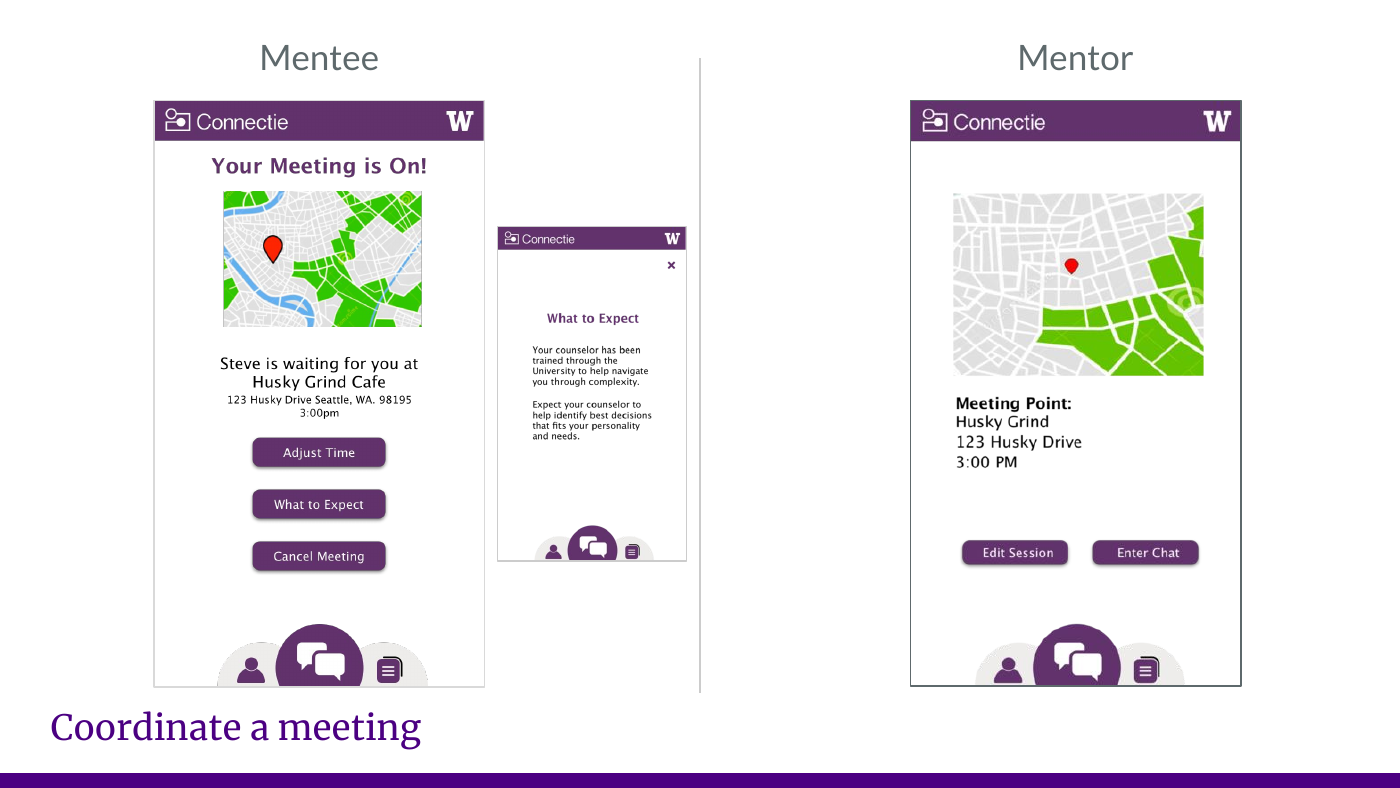
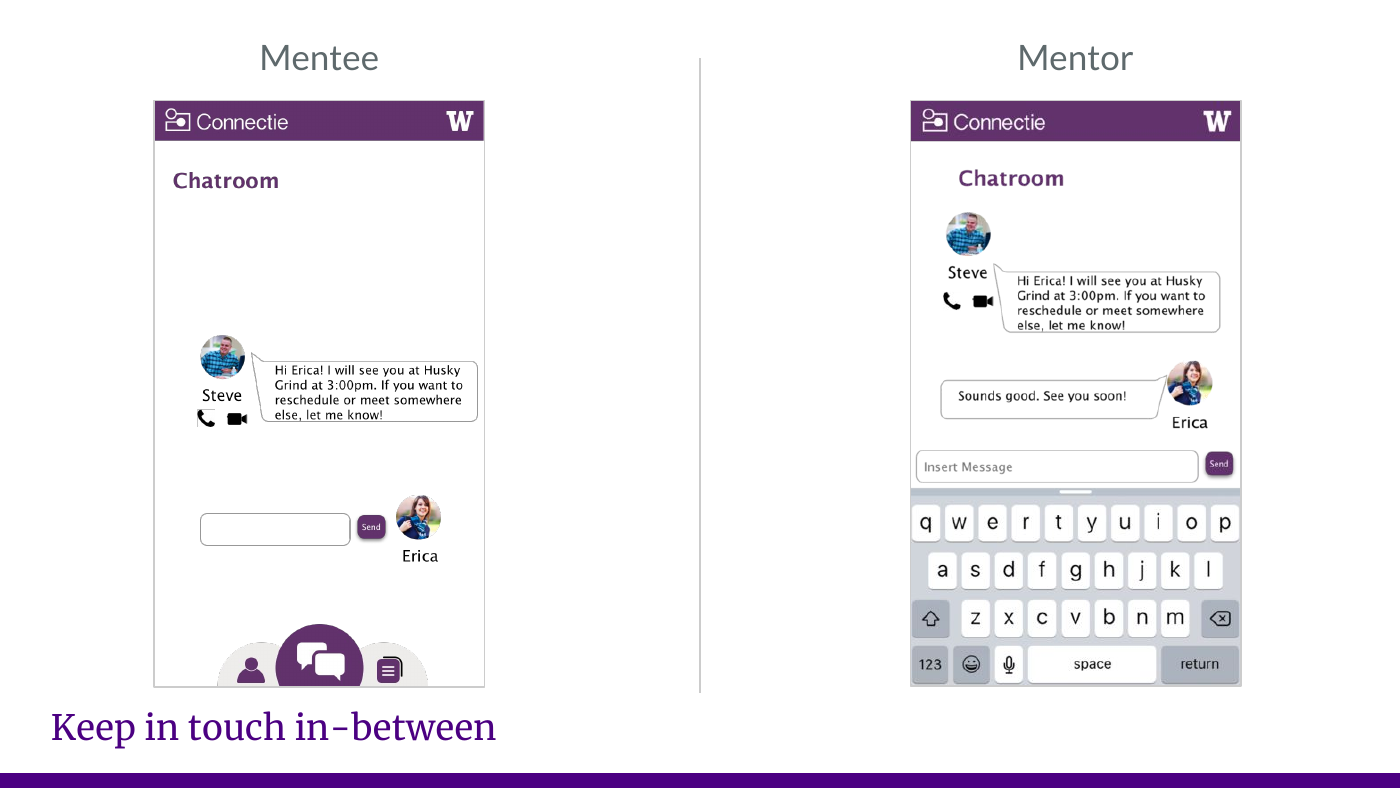
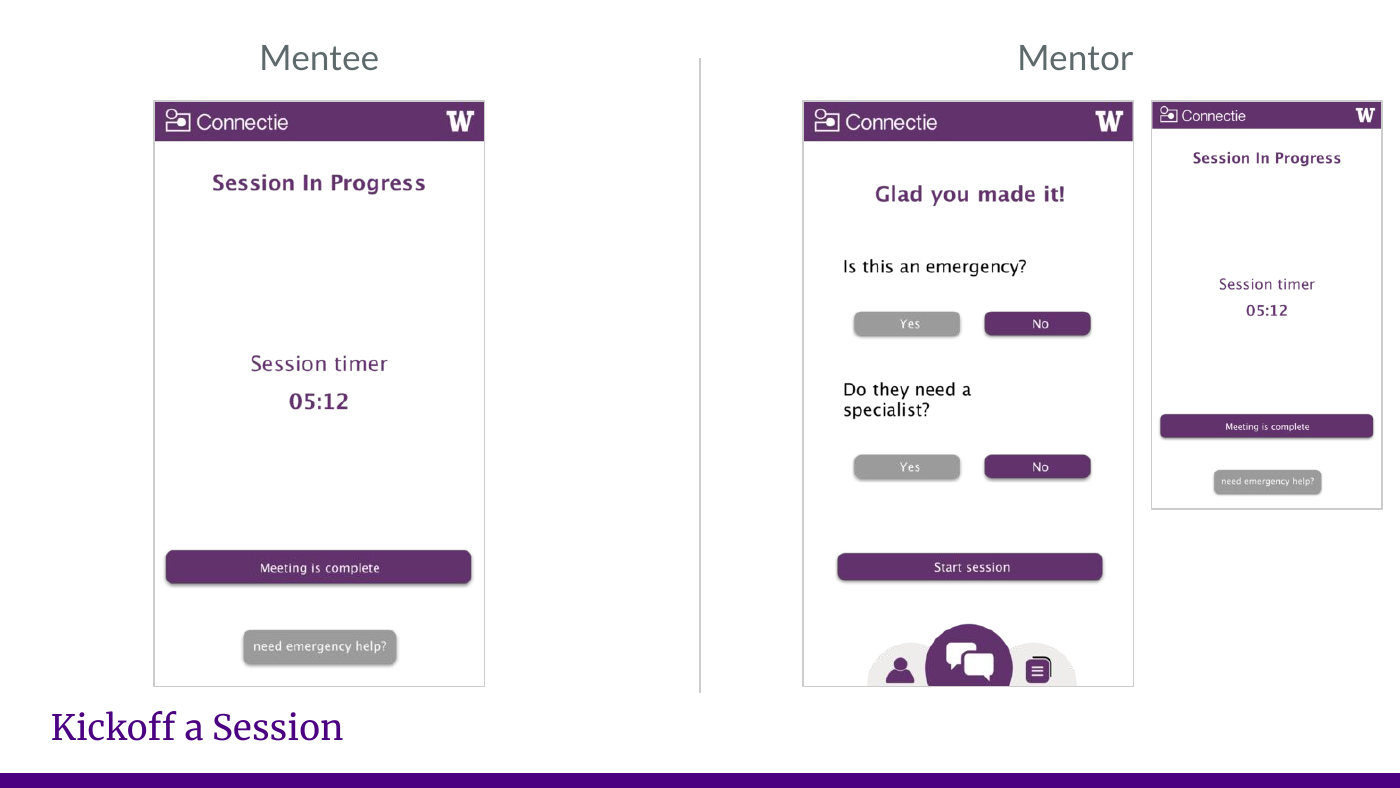
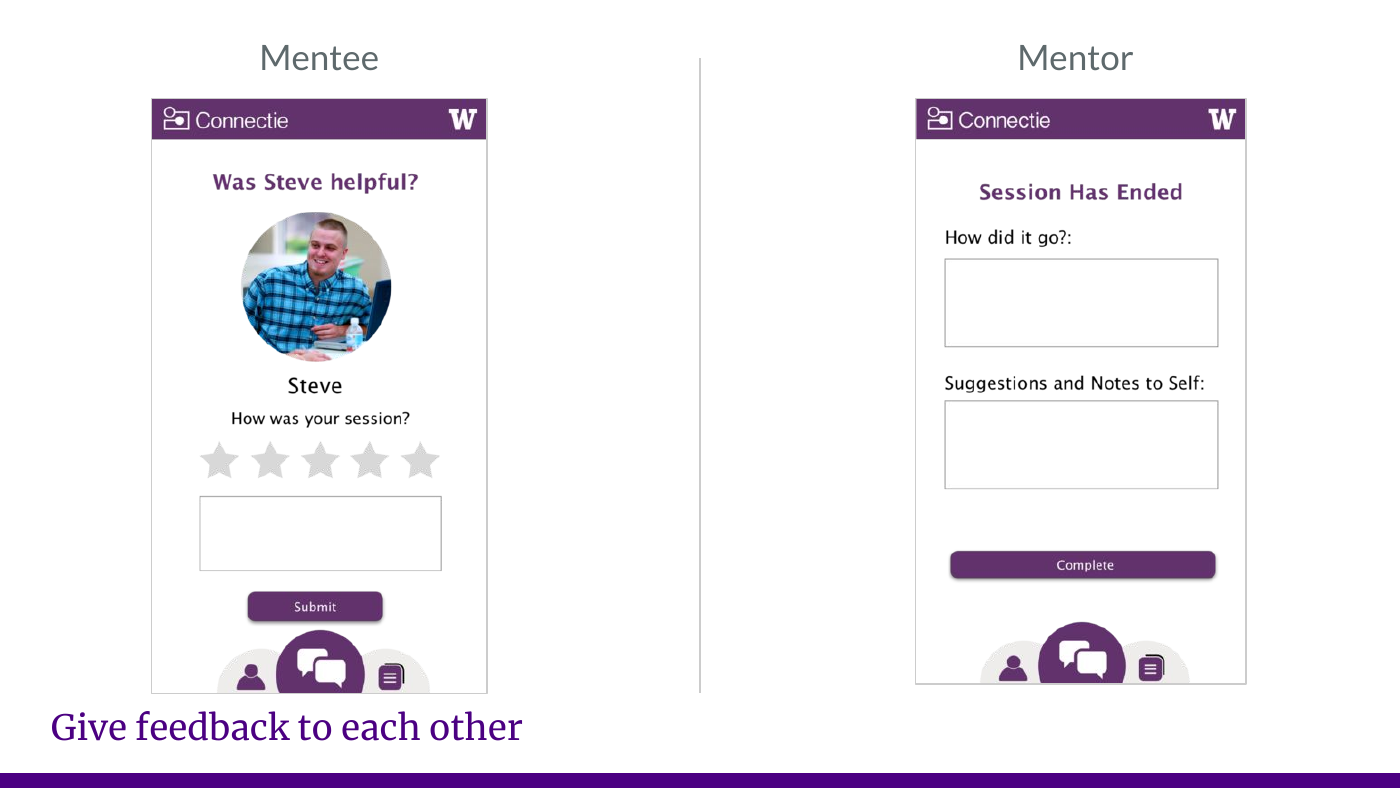
Connectie became a college-centered, peer-to-peer mentoring concept informed by a stepped-care model. The screens made the service tangible on both sides: choosing a mentor, explaining a need, sending a request, coordinating a meeting, staying in touch, starting a session, and exchanging feedback.
The prototype exposed the handoffs between asking for support and offering it, so the team could examine a complete interaction rather than a collection of features.
The process overview records paper prototyping and usability testing, followed by a low-fidelity prototype, another usability test, more research, and a high-fidelity prototype. The presentation’s tactical synthesis says the combined concept tried to address too much at once.
Iteration supported a narrower mentoring direction. The deck does not provide test-by-test observations, participant counts for these sessions, or measured usability improvements.
The final reflection returns to mentor onboarding, safety, repeat meetings, past chats, and testing both the request for help and the acceptance of a mentoring task. It also proposes investigating care and support models.
These are the next needs and research questions, not completed capabilities. The end of ten weeks created a more focused starting point for another cycle.
03 / TASTE
Triage → Analysis → Synthesis → Tackling → Extraction. This is a second view of the same ten weeks: how the team managed scope, chose a direction, made it tangible, and identified the next work.
The design question changed three times: from helping incoming students focus, to balancing academic and social life, to enabling helpful dialogue. The team recognized that covering every student difficulty would make the concept too broad.
Through the TASTE lens, triage is the decision to focus on access to a mentor within the ten-week constraint. It is distinct from the early project’s “Transition Triage” working title.
The original hypotheses emphasized time pressure, distraction, and mental wellness. Research showed a wider mix of concerns and that many were not unique to first-year students.
The opportunity had to account for varied situations instead of assuming a single focus problem. The deck supports that change in understanding; it does not establish the prevalence of each concern across a university.
The team’s synthesis identified mentors as a source of help across the situations they had encountered. Principles such as usefulness and simplicity helped turn that observation into a more coherent concept: a system that makes person-to-person connection possible.
The decision joined diverse student needs to one interaction model, while leaving the content of the conversation open to the student’s circumstances.
The final screens pair mentee and mentor experiences across the request, meeting coordination, between-session contact, session kickoff, and feedback. This makes the responsibilities and transitions visible enough to discuss and test.
Here, delivery means a designed prototype and project presentation. The deck does not document a production service, university pilot, or operational mentoring program.
The closing slide proposes further testing, mentor onboarding and safety work, improved follow-up, and exploration of university pilot and ownership partners. These proposals show what the team believed would be needed beyond the classroom project.
The retrospective lesson is to separate a promising connection model from the research, safeguarding, and service ownership required to put it into practice.
The final screens show the proposed experience. The names, messages, and profiles belong to the original prototype; these are design artifacts, not records of a live mentoring service.
The team produced a mentoring concept and prototype, together with a clearer account of the work that remained. The strongest lesson in this ten-week arc is that gathering more problems does not require building more features. Research can instead reveal the simpler relationship that connects them.
Research methods and themes, three design questions, design principles, an iterative process, and paired mentee–mentor screens.
Further evaluation of requests and mentor acceptance, onboarding and safety design, follow-up interactions, and potential pilot and ownership partners.
This account uses the team’s 24-page presentation and the ten-week duration recorded with the project. It does not claim launch, adoption, health outcomes, or measured usability gains. Individual task ownership beyond the team credit is not established in the deck.
EXPLORE RIPEN & TASTE IN MY PRACTICE →SOURCE COLLECTION
The design questions, research findings, process overview, prototype, and future directions.